

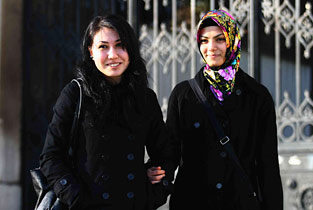
Conducted recently by the Open Society Institute (ATE), a study called " Being Different in Turkey" suggests that non-devout and secularist people in Turkey are subjected to social pressure to attend Friday prayers, fast during the month of Ramadan and/or wear a headscarf. This pressure has been on the rise since the ruling Justice and Development Party (AK Party) swept to power (in 2002), according to the study. It suggests that a government policy of making appointments to local administrations on the basis of political and religious beliefs, rather than competence, is forcing non-devout Turks to change their habits in order to protect their businesses or jobs.
The study, however, has drawn the ire of many poll supervisors and sociologists, who say a poll conducted with a very limited number of respondents belonging to a certain ideological group is far from being scientific and representative of the general structure of the society.
" Considering the sampling of the study and the small number of people who responded to questions asked by journalists, selected by the ATE itself, I can say that this study cannot be taken as representative of the whole of Turkey," said Professor Özer Sencar, owner of the Ankara-based MetroPOLL Strategic and Social Research Center.
The " Being Different in Turkey" study was conducted through one-to-one interviews in 12 provinces among 401 people. Participants of the study were elected from the provincial branches of the staunchly secularist Republican People's Party (CHP), the likewise secularist Atatürkist Thought Association (ADD), the Education Personnel Union (Eğitim-Sen), various Alevi associations, women's organizations and chambers of commerce and industry.
" Making deductions about all of Turkish society through the responses of a limited number of people is neither ethical nor scientific," Sencar stressed.
İbrahim Uslu, director-general of the ANAR Research Company, criticized the research for choosing respondents who hold prejudiced views of conservative and religious people. " The ATE should explain why it chose to limit the scope of the study to a certain group. Such an unscientific study will not be taken into consideration by any institution, including the Turkish Statistics Institute [TurkStat]," he noted.
The survey also talks of increased social pressure on non-devout people since the appointment of AK Party supporters to local administrations, schools and hospitals, which respondents say is changing the social atmosphere in Turkey in a worrying direction. Participants of the survey give various examples of social pressure, including that non-religious nurses were put on permanent night shifts, that some landlords refused to take female students as tenants unless they wore a headscarf, that secular civil servants were overlooked for promotion, that people were beaten or reprimanded for smoking or not fasting during Ramadan. They blame the AK Party for failing to promote tolerance for other groups' rights and freedoms while in government.
The term social pressure was first put forward last year by Professor Şerif Mardin, a prominent social scientist. Mardin expressed concern that there would be pressure on women that do not wear a headscarf if female students are allowed to attend university courses wearing headscarves.
Binnaz Toprak, a professor at Boğaziçi University and the head of the ATE team conducting the survey, defended the study, saying the team had no option but to choose from an overwhelming majority of respondents among Alevis and CHP supporters. " We had no opportunity to ask respondents if they were secularists or not and so we preferred to choose respondents among certain groups. However, we cannot say the survey reflects the absolute truth; there may be untrue statements among our respondents' answers," she stated.
Speaking to The Associated Press, Nihat Ergün, deputy chairman of the AK Party's parliamentary group, rejected the findings of the study, saying his party does not exert pressure or discriminate against the non-devout.
" The picture presented by the study does not reflect Turkey's realities," Ergün said. " Even in our party we have women in headscarves working alongside women who do not wear headscarves and no one has ever complained of any pressure."
Political science expert Professor Mümtaz'er Türköne said the study's findings are not worthy of discussion as there are serious flaws regarding the sampling method. " If there is a problem with a study's method of sampling, the findings cannot be taken into consideration and the study cannot be considered to be representative. I believe the findings of the ATE study are controversial and are thus not worthy of being discussed," Türköne stated.
Fatma Barbarosoğlu, a sociologist, said poll supervisors should attach great importance to the selection of cities and respondents when conducting a comprehensive public study. " Looking at this survey, it is not possible to say that Turkey is heading for a more conservative future. Poll supervisors should conduct their studies in more cosmopolitan cities for a more correct assessment," she noted.
Yeni Şafak columnist Ayşe Böhürler termed the survey " prejudiced" as it dwells on social pressure on secularists while it makes no mention of pressure faced by devout Muslims. " The main idea of the survey is that being prejudiced against those who are different is most observed among those who define themselves as devout Muslims. So, what about those subjected to peer pressure coming from secularists? Can you imagine what kind of attitude she is subjected to when a women covers her hair? Let me explain. First of all, those who consider you a normal person when you don't cover your hair start to behave as if you have leprosy when you wear a headscarf," Böhürler said.
Ali Bulaç, a sociologist and columnist for the Zaman daily, agreed and said the ATE supervisors should have interviewed people from several other associations and institutions for more balanced results. " Respondents of the survey described the situation in Turkey based on their own convictions. However, poll supervisors should have interviewed people from the Independents Industrialists and Businessmen's Association [MÜSİAD], the Association of Human Rights and Solidarity for Oppressed Peoples [MAZLUM-DER], the Turkish Foundation for Volunteer Organizations [TGTV] and the Freedom Association [Özgür-Der]," he said.
Bulaç also criticized the survey for using a problematic style of sampling and for lacking political objectivity. " This survey is not sound because it is based on a certain ideology and is prejudiced against segments of the society it considers to be its rivals. Those who have the preoccupation to provide materials for their political arguments either distort the facts or resort to untrue statements. The participants of the survey belong to groups that oppose the AK Party," he noted.
BETÜL AKKAYA DEMİRBAŞ İSTANBUL


