

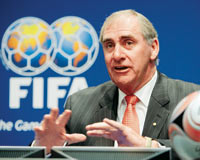
Loud, brash and at times outrageous, Pound attacked the doping problem with guns blazing, his take-no-prisoners approach keeping the anti-doping battle in the headlines, elevating sport's dirty little secret into a mainstream issue.
The softly-spoken Fahey has displayed no such penchant for shooting from the hip, his thoughts and words measured carefully, and prefers to work away from the spotlight his predecessor often sought out.
However, the former rugby player, whose three-year term started on Jan. 1 2008, cautioned that his preference for diplomacy should not be taken as sign that he had no taste for a fight.
" If it becomes a question of treading on toes or upsetting people by confronting something head on, I have no difficulty with that if the situation arises," Fahey told Reuters.
" On the other hand, I would much sooner get cooperation and constructive outcomes if they can be achieved by a quieter approach.
" I don't think there is any one method. I think you should use all the weaponry available to you.
Verbal combat
" There is no doubt we need to continue to communicate the message and the best way to do that is to have it up there in the headlines.
" Whenever there is a necessity to make a statement, I am more than willing. That is not to say I seek opportunities. It is not my nature.
" I admire the capacity of Mr. Pound, in the past, to put this particular topic on the radar screen with his ability to communicate that message and I will do my best but I think we have changed."
In eight years spearheading the anti-doping crusade, Pound routinely engaged in verbal combat with everyone from seven-times Tour de France champion Lance Armstrong to the commissioners of North America's major professional sports leagues, the NBA, NFL, NHL and MLB.
The former Olympic swimmer was no stranger to lawsuits and threats.
He openly feuded with Armstrong, who attempted to have the Canadian International Olympic Committee (IOC) member sanctioned by the IOC, and once joked that his face could be found on a dartboard alongside that of Osama bin Laden in the offices of the major sports' commissioners.
There are no signs that Fahey, the former Premier of New South Wales and Australian Finance Minister, has fostered such intense dislike.
While the anti-doping fight continues down a road mapped out by Pound, Fahey now has his hands firmly on the wheel.
The Australian acknowledges that the big names Pound helped to catch in doping dragnets have acted as ominous warnings to drug cheats.
They also caught the attention of governments, who were at first reluctant to join the doping fight but now, in many respects, lead the way.
Fahey hopes to develop those relationships with governments and law enforcement agencies. At a recent board meeting he announced an agreement of cooperation with Interpol and believes such pacts will be key to eradicating drugs from sport.
Behind Pound's forceful presence, WADA developed an Anti-Doping Code and pushed UNESCO to adopt it as the International Convention against Doping in Sport.


