

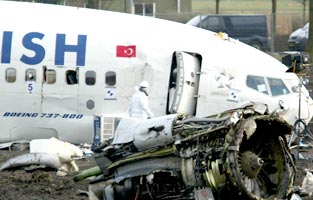
Five Turks and four Americans were killed when the Boeing 737-800 plunged into a muddy field short of the runway at Schiphol Airport last Wednesday.
Among the dead were three pilots and a flight attendant. Releasing the initial results of an investigation launched into the incident at a news conference in The Hague, Vollenhoven said the plane had been at an attitude of 595 meters when making its landing approach to Schiphol airport, although the altimeter recorded an altitude of around ground level.
The plane was on autopilot and its systems believed the plane was already touching down, he said. The automatic throttle controlling the two engines was closed and they powered down. This led to the plane losing speed, and stalling.
He said the pilots realized the failure in the altitude indicator but did not give much heed to it adding that information about the plane's former eight flights could not be reached after the examination of the black box.
 |
The plane started to land with a speed of 170km/h but its speed was supposed to be 260km/h and it went down in muddy land. Vollenhoven said Boeing had been instructed to warn its clients about possible problems with altimeters on similar aircraft. The Boeing 737-800, was severely damaged as it quickly descended. The impact split the fuselage near the front of the wing, while the tail and a rear section of the body were sheared off. Vollenhoven said Dutch Safety Authority has been conducting two separate investigations into the accident in line with its principals.


