

Though Turkey has made a number of significant reforms as part of its bid to join the European Union, it is still under the influence of some of the decisions made by the MGK on Feb. 28, which were intended to strictly protect the state ideology.
Uneasy with the existence of a conservative party -- the Welfare Party (RP) -- in government, the General Staff began briefing members of the judiciary, university rectors and journalists on religious fundamentalism at its headquarters in early 1997. The MGK made several decisions during a meeting on Feb. 28 and presented them to then-Prime Minister Necmettin Erbakan (also the leader of the RP) for approval. Erbakan was forced to sign the decisions. Erbakan subsequently resigned, handing over the Prime Ministry to his coalition partner, Tansu Çiller.
The MGK decisions, 18 in total, are still largely under implementation, and Turkey is prevented from taking any steps that could go against them. The decisions seem as though they will maintain their grip on the country for some time to come, as openly expressed by former Chief of General Staff Gen. Hüseyin Kıvrıkoğlu, who once said, " Feb. 28 will last 1,000 years!"
 The General Staff was uneasy with Erbakan's conservative Welfare Party being part of the government and held frequent briefings on fundamentalism. |
Among these decisions is the strict protection of the principle of secularism and the invention of new laws to protect it if existing laws fall short of doing so. This decision is so strictly implemented in our day that any moves that are considered to endanger secularism in the country are immediately fought against. Two recent examples of this are the blocking of amendments lifting the longstanding ban on headscarves at universities and a closure case filed against the ruling Justice and Development Party (AK Party) on the grounds that the party had become the focal point of anti-secular activities.
In early February 2008, the AK Party, with the support of the opposition Nationalist Movement Party (MHP), passed a constitutional amendment package that would lift the ban on wearing the headscarf on university campuses.
However, upon an appeal by the staunchly secular Republican People's Party (CHP) and its ally, the Democratic Left Party (DSP), the Constitutional Court ruled in early June that Parliament had violated the constitutionally enshrined principle of secularism when it passed amendments to remove the scarf ban and annulled the amendment.
 Tanks appeared on the streets of the Turkish capital in 1997 as part of the Feb. 28 " postmodern coup," orchestrated by the Turkish Armed Forces. |
Soon after came the closure case against the governing party last March on charges of anti-secularism. The Constitutional Court, however, ruled in late July not to disband the party.
Former deputy confesses to having been forced to resign Hikmet Aydın, a former deputy of the True Path Party (DYP), stated that he was forced to resign from his post during the Feb. 28 period, the Aksiyon weekly reported this week. According to the report, Aydın said former Motherland Party (ANAP, now ANAVATAN) leader Erkan Mumcu told him to resign and that otherwise he would be among the first to be imprisoned if a military coup were staged. Mumcu, in response, said he did not even remember ever seeing Aydın's face. "Don't make me address a man who is not taken into consideration by anyone. My stance against Feb. 28 is well known by everyone," he noted. Şükrü Karaca, who was an advisor to former Prime Minister Çiller, claimed the military made use of the 1996 Susurluk affair, which exposed links between the Turkish state, the criminal underworld and Turkish security forces, during the Feb. 28 era. According to Karaca, the military benefited from the public upheaval against deep state gangs and turned the anger of society against the government with the ulterior motive of overthrowing the coalition government in 1997. |
Another strictly implemented MGK decision dating back to the Feb. 28 era involves tough control over private schools, dormitories or foundations with suspected links to religious or conservative groups. Many foundations were shut down shortly after Feb. 28 on the grounds that they were controlled by groups with roots in reactionaryism.
This decision, however, has had a positive impact on education -- namely, the prolongation of compulsory education to eight years.
A number of newspapers were closed down after the 1997 postmodern coup based on a decision by the MGK that required monitoring of press organs that were suspected of fomenting hatred against the Turkish Armed Forces (TSK).
The military was also cleared of members with suspected ties to religious groups, a tradition still widely observed in our day during Supreme Military Council (YAŞ) meetings. YAŞ convenes twice a year to decide on promotions and retirements within the TSK. These YAŞ meetings are also where officers suspected of engaging in anti-secular activities are expelled from the TSK.
One of the MGK decisions made on Feb. 28 aimed to prevent the entrance of religious individuals or groups into public institutions, universities, bureaucracy, judiciary and politics. Based on this decision, headscarf-wearing females were denied their rights to enter university campuses and to be employed in public institutions, and a number of political parties with religious roots were disbanded.
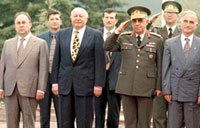
 The National Security Council made several decisions during a meeting on Feb. 28 and presented them to Erbakan for approval, which he was forced to sign. |
Another MGK decision that is still widely implemented prevents the donation of skins of sacrificed animals to any organization or institution other than the Turkish Aviation Board (THK). Since the 1997 postmodern coup, people have either directly or indirectly been forced to donate their alms and the skins of sacrificed animals to the THK.
Generals express desire for impact of Feb. 28 to last forever
Turkey's high-ranking military officers seem content with the ongoing impact of the Feb. 28 process on society. Former Chief of General Staff Gen. Kıvrıkoğlu, for example, once stated in an interview that Feb. 28 would last as long as acts of reactionaryism last. "If the tendency toward reactionaryism lasts for 500 years, Feb. 28 will last for 500 years. If the tendency toward reactionaryism lasts for 1,000 years, Feb. 28 will last for 1,000 years!"
Current Chief of General Staff Gen. İlker Başbuğ said last September that the philosophies, thoughts and tendencies that took Turkey to Feb. 28 are still active in society. "The conditions of Feb. 28 have not changed yet," he noted.
Additionally, former President Süleyman Demirel stated that Feb. 28 is still continuing. "If some circles did not attempt to abuse people's religious feelings and they did not enter mosques, schools and military headquarters, then Turkey would be at ease and would not be forced to distance itself from religion. This is what Feb. 28 is. Is Feb. 28 continuing? Yes. Why? Because the secular state is continuing. Feb. 28 has been active since the foundation of the Republic of Turkey," he remarked.
 Tanks appeared on the streets of the Turkish capital in 1997 as part of the Feb. 28 " postmodern coup," orchestrated by the Turkish Armed Forces. |
Society unhappy with continuation of Feb. 28
Contrary to the desires of coup-supporting generals, society is not happy with the impact of the Feb. 28 process on their lives. Several politicians and representatives of civil society organizations have expressed their dislike of the lasting grip of the postmodern coup.
"The decisions of the Feb. 28 period are still under implementation. No single individual dares to take a step against them. Political parties are unable to go beyond the borders set by these decisions," stated ruling Justice and Development Party (AK Party) Kahramanmaraş deputy Avni Doğan.
Reşat Petek, a retired chief prosecutor, stressed that Feb. 28 has made its impact felt on judicial bodies, as well. "Briefings held by the TSK during the Feb. 28 era are still influential on members of the Constitutional Court, the Council of State and the Supreme Court of Appeals. Look at how the 367 decision emerged or at the relations between the military, the judiciary and politics," he said.
Ömer Faruk Gergerlioğlu, chairman of the Association of Human Rights and Solidarity for Oppressed Peoples (MAZLUM-DER), stated that society is unwilling to witness the impact of Feb. 28 any longer.
"The Turkish society demands that problems be solved through civil politics, not through military interventions. Society extends no support to acts aimed at giving rise to another coup d'état. On the contrary, it voices its reaction against such attempts. Society is fully aware that the Feb. 28 postmodern coup was the work of Ergenekon," he said.
Ergenekon, a clandestine organization charged with attempting to incite chaos and undermine stability in Turkey with the hope of triggering a coup, is accused of being behind a number of coups and coup attempts in Turkey.
Remembering Feb. 28 process
The process that started the downfall of the RP-True Path Party (DYP) coalition government began with the 1995 parliamentary elections. Because no political party garnered enough votes to establish a government on its own, a coalition government was formed by Erbakan's RP and Çiller's DYP. The two parties founded their government on June 8, 1996.
The Turkish military, uneasy with the existence of a religious party in government, began preparing to topple the government. The military was assisted by the Turkish Union of Chambers and Commodity Exchanges (TOBB), the Confederation of Turkish Labor Unions (Türk-İş), the Turkish Tradesmen's and Artisans' Confederation (TESK), the Turkish Confederation of Employers' Unions (TİSK) and the Federation of Revolutionary Workers' Unions (DİSK).
Certain mistakes committed by the coalition government facilitated the military's work to overthrow it. Among these were official visits by then-Prime Minister Erbakan to Libya and Nigeria, which caused tension between the government and the General Staff. Allegations were also made indicating that officers discharged from the military were being employed in municipalities run by RP mayors. A fast-breaking dinner held with the participation of religious leaders at the official residence of the prime minister, plans to build a mosque in İstanbul's Taksim Square and the reconversion of the Hagia Sophia into a mosque heralded a new era of fear.
 Having signed off on the MGK's decisions, Erbakan resigned, handing over the Prime Ministry to his coalition partner, Tansu Çiller. |
A polemic between the mayor of İstanbul's Sultanbeyli district, Nabi Koçak, and Gen. Doğu Silahçıoğlu, who asked for the erection of a statue of Mustafa Kemal Atatürk in the town, increased the tension. High-ranking military officers convened in Gölcük on Jan. 22, 1997, to discuss whether religious fundamentalism had become influential in the country. Labor and business unions, professional organizations and trade associations began speaking out against the government. Women's organizations held rallies to protest what they saw as the return of Shariah (Islamic law) and promoted secularism. Then came the General Staff's briefings on religious fundamentalism and the MGK's Feb. 28 meeting, where it made decisions Prime Minister Erbakan was forced to approve.
Erbakan subsequently resigned, handing over the Prime Ministry to Çiller. He presented the signatures of 270 deputies, who stated that they would vote for the suggested Cabinet, to President Demirel, who was expected to ask Çiller to form the Cabinet; however, surprisingly, he asked Motherland Party (ANAP, now ANAVATAN) leader Mesut Yılmaz to do so. The government formed by Yılmaz was unable to get a vote of confidence in Parliament. At this point, Demirel intervened in the process and asked his confidants in the DYP to resign and join the Party for a Democratic Turkey, founded by Hüsamettin Cindoruk, thereby forming an alternative coalition government.


