

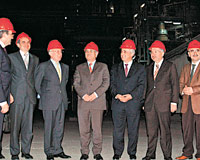
Speaking at the inauguration of the central bank's two-day international conference on "Globalization, Inflation and Monetary Policy" in İstanbul, Yılmaz said that the international financial system was going through a critical period and stated that "indicators on risk perceptions are at their highest all-time levels."
"Despite the measures taken, the shrinkage in the credit markets and unwillingness by banks to provide credit facilities still continue," he warned. He nonetheless sought to reassure bankers and investors that "the Turkish banking sector is relatively prepared for fluctuations in terms of foreign exchange liquidity." He said the management of money by the central bank had a structure which could efficiently meet the liquidity needs of the banking sector.
"The way that developing countries will use their foreign exchange reserves is of great importance during the current difficult period," Yılmaz said.
Yılmaz also stressed that the central bank would continue to take additional measures when required, in order to support foreign exchange liquidity and help the foreign exchange market to function effectively.
As such, the central bank yesterday announced that, "Effective today, the central bank has decided to extend the maturity of foreign exchange deposits borrowed by banks within the predetermined borrowing limits from one week to one month; and to reduce the lending rates from 10 percent to 7 percent for the dollar and to 9 percent for the euro in the foreign exchange market."
Another dimension of the crisis highlighted by the minister was the "freezing of private credit and the tendency of capital to flow back to where the current crisis originated."
Turkey is more vulnerable than other countries to global liquidity shortages because so much of its economy is dependent on foreign investment and capital flows -- both portfolio and foreign direct investment (FDI). Overcoming the challenges posed by international liquidity shortages and maintaining international confidence in the Turkish banking sector has been cited by many as being the key to Turkey's ability to weather the storm.
The Turkish banking sector is considered by many analysts as being amongst the most sound in the world. Indeed, Yilmaz re-affirmed this notion yesterday when he said, "Since securitized products are rarely used in the Turkish banking sector, the ongoing financial turmoil has not put a marked pressure on local banks through that channel."
In an interview with Today's Zaman last week, Turkish Economy Minister Mehmet Şimşek stated: "In the past, the banking sector was so weak that it usually exacerbated any problems in Turkey. This time around, it looks like the banking sector is actually going to help cushion the crisis." Some analysts have gone so far as to point to this statement, and statements like it, to suggest that the crisis presents opportunities for İstanbul to emerge as a regional financial hub as many other regional banking sectors crumble.
Pointing to additional positive outcomes of the crisis, Yılmaz drew attention to the likely prospect that the current account deficit, historically a source of vulnerability for the Turkish economy, is likely to experience a sharp drop in the upcoming period due to a correction in commodity prices, the slowdown in economic activity and the depreciation of the Turkish lira.
He called on the private sector to take precautions, as the global financial sector had begun spilling over to the real sectors of many countries, and said the Turkish non-financial sector should prepare for slackening demand in export markets.


