

The will to keep people from learning is so strong that Turkey reforms social security every three years to make sure the laws are changed when people are just getting the hang of things.
This is what Ali Tezel, a modern-day Marko Paşa (or Marko Apostolidis, the first Ottoman doctor to be given a military title in mid-18th century), believes is the origin of his reputation as the ultimate authority to direct your questions regarding your rights as an employee, with the guarantee that you will get an answer.
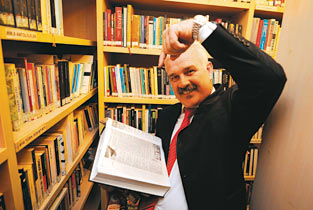
Tezel, a gallant man in his early 40s with a spirited smile on his face, describes the early years of his career as Turkey's only social security expert, a full-time consultant to the people and an empathetic listener over coffee in the cafeteria of broadcaster NTV's office, where he hosts a 30-minute program every week, doing what he has been doing for most of his life: answering questions on retirement, salaries, resignations, compensations, seniority and other labyrinthine troubles of work life.
Coming from a poor family, he was educated at a boarding school funded by the state. He graduated from a medical vocational high school in 1985. As a public health specialist, he found employment on the night shift at the ER department of an İzmir hospital in 1989.
He dedicated his daytime to studying the work economy and industrial relations at the 9 Eylül University. Completing in 1995, he was hired the Social Insurance Institution (SKK) as a public accountant and relocated to Istanbul. In the expensive city, he started to write an advisory column on social security regulations and laws in the Akşam and Zaman dailies under a pseudonym.
The demand for information was so high that he became the star of the social security world. Today, he has authored 12 books on various social security and accounting issues and hosted countless TV programs on numerous television channels. He estimates that he has answered 200,000 questions -- on the phone only -- in the past 10 years from employees, public accountants, business owners, trade and labor unions, CEOs and even state social security agencies.
"I answer questions from all segments of the society," he says, adding the trick is in his empathy skills. "I can really empathize. If I'm talking to an employee, I answer like one. If I am answering the question of a business owner, then I can give the answer from their point of view. People like that." In addition to the never-ending phone calls, he gets about 3,000 e-mail questions per day.
An obsession with answering questions
His power for empathy, however, is not the only factor that has made him the most trusted source for all social security questions. "I like answering questions. I feel bad when I can't answer someone's question. I will most definitely look it up, if I can't," he explains as perhaps the most important ingredient of his success. "If confronted with a question they can't answer, my colleagues would mostly say, 'Oh, that's outside my field.' I never could do that even as a kid," Tezel says, revealing the key catalyst that, for years, drove him to read and read about every detail in the legislation.
Tezel resigned from his post as a chief inspector and as head of the Group Administration Department at the SSK, which recently became part of a structure called the Social Security Institution (SGK), in a government-sponsored reform bill demanded by the International Monetary Fund (IMF) for the release of credits -- which he vehemently opposes.
Interesting times, interesting questions
The reason he quit the SGK inspectors' board was his opposition to the new social security law.
"There were investigations into me when I criticized the law," he says. "One day, I discovered in the system that 10,000 people quit their retirement salaries and started new jobs, this way, using a loophole in the system that would make them entitled to a 50 percent higher retirement salary.
"I told the officials, but they told me to let go of it. Turns out, it was all their relatives and cronies. I published this in the Akşam daily, after which 55,000 people made use of the same right. That's when I started getting along well with the people, but not so good with the state."
He also recalls that he recently found another loophole, after which 1.5 million parents registered their children with the SGK, entitling the children to earlier retirement. "They investigated me for this. When I get a notice, I'll hang it on my office wall as medallion," he said. "So I quit, and opened a social security counseling business."
His career as an avid question replier and his resignation from his government job has paid off. "I saved myself from the government job, and became rich. Ordinary people whom I've helped buy me presents when they find out I don't take cash. My belt, my shoes, my shirt are all presents from the people." Tezel proudly says he now owns a duplex and a summer house in the township of Şile.
What is the most frequently asked question on social security? Without flinching, "Retirement age and salary," Tezel instantly answers. Among the most interesting questions he has gotten are from people curious about the change in their retirement age after sex-change operations. [Answer: If you have a sex-change operation, you retire at the age stipulated in the law for your current gender. So if you change from a man to a woman, the retirement age will be 60 and not 65. Changing your sex to become a man would delay your retirement for another five years]. Another question that was not quite ordinary was from a woman jailed for parental homicide. She wanted to know whether she was still entitled to her dead parents' retirement checks. [Answer: Yes, she is. But it was later revealed the person who penned the letter was the woman's brother, posing as her.]
IMF needs a Turkey addicted to sickness, medicine
What exactly would Tezel say is the key problem of the much disputed and highly controversial social security reform that the IMF insists Turkey passes? Tezel explains it in simple terms:
"The main problem is that it divides the health aspect and the retirement aspect of the system into two systems. It has made major, but gradual, reductions in the retirement part. So you will get less money in that department. They increased social security rewards in the health compartment. It is now so easy to access any hospital or medicine, in comparison with the past.
"Here are the figures, in 2004: Turkey's social security expenditure on health was YTL 10 billion. As of this year, that went up to 46 billion. Retirement expenditures rose by 10 percent only in each year between 2004 and 2008.
"And where does all this health spending go to? To pharmaceutical companies and hospitals. Currently, all drug manufacturers in our country except one belong to foreigners. Seventy percent of our hospitals have been bought by foreigners.
"The IMF is imposing this reform on us. They are taking much more than they have given in credits. I am not saying this politically, but the IMF is forcing us to do this. For three and a half years, they canceled the release of a loan because the social security reform passed. The total we received was $3.5 billion, but they have taken about $25 billion back. So what they take in terms of medicine and health spending is four or five times more than what they have given."
The system now thrives on sickness and more medicine. Tezel believes that the Constitutional Court will cancel about 20 articles of the reform bill, which might make improvements to the retirement part of the system. "But taking back any of the rights given to a people who cannot do without medicine would be political suicide for any government," he says.
Social security should be taught in schools
Tezel points out that the average employee spends two-thirds of his life in the workplace. "Social security starts even before you are born and continues even after your death in the form of payments to your children or widowed spouse." He gives the example of France, where people march for their rights even at the slightest change to the law. According to Tezel: "People should be taught their social security rights, so they can exercise them. There should be classes in schools, businesses and agencies."


