

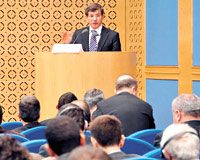
There are only two options in the globalizing world for Europe, he said, and these are either integrating with neighboring regions or for Europe to build " an unseen [Great] Wall of China" around it. " Walls cannot solve problems. In this age of globalism, walls should not be an option," he said at a seminar titled " Turkey and Europe after the French Presidency of the EU" organized by the International Relations Institute of France (Ifri) and the Turkish Economic and Social Studies Foundation (TESEV).
Davutoğlu added that Europe can achieve integration by establishing geostrategic extensions into neighboring zones, maintaining a dynamic demographic and creating a multicultural environment. " France has a multi-dimensional geography. It has Atlantic and Central European ties with extensions to Africa," he said, adding that there are only three other European countries with such a character of " natural extensions" : Britain, Germany and Spain. He said Turkey is the only candidate country with the same attributes, since Turkish ties extend to the Middle East, the Balkans, the Caucasus and Europe.
" We have more Albanians living in Turkey than in Albania. We have more Chechens living in Turkey than in Chechnya. We have more Bosnians living in Turkey than in Bosnia. We have more Kurds living in Turkey than in northern Iraq." Davutoğlu argued that this character of Turkey is an asset for Europe if it continues to be involved in the world scene.
" How is the world going to be in 2050? Where is the European Union going to be standing? Where is France going to be standing? We have to develop a common vision to understand that, and for that we need each other," he stressed.
Likening the Turkish-French relationship to a three-legged table comprising bilateral relations, relations related to the EU and relations regarding regional and global issues, Davutoğlu said, " Nobody can expect from Turkey that one leg should be avoided."
French senator: Better with us
French Senator Pierre Fauchon said in his welcoming remarks that he supports Turkey's accession to the EU. " The presence of Turks among us is good. It is better for Turkey to be with us rather than lost in other challenges," he said.
He also added that he " admired" the Turkish Constitutional Court, which ruled this year not to close the ruling Justice and Development Party (AK Party) and instead issued a " warning" in the case against the AK Party for being the " center of anti-secular activities." Most observers noted that the case had kept the government busy domestically, diverting efforts to pursue reforms that would accelerate the EU accession process.
Another senator, Xavier de Villepin, who is also on the Ifri board of directors, commented on a bill that would make denial of the Armenian " genocide" a crime. The bill was accepted at a sub-commission in the French legislature, but it has not yet come up on the Senate agenda.
" The issue could boomerang on us. Others could pass similar regulations against us. It could create huge diplomatic problems and make international relations difficult," he said.
Turkey objects to the claims of " genocide," arguing that the Armenian death toll during World War I at the hands of the Ottoman Empire has been exaggerated and that most victims died from starvation or disease. Turkey also argues that many Turks were killed by Armenian groups allied with the enemy against Turks.
Meanwhile, Mensur Akgün, TESEV's foreign policy director, mentioned the stalled state of the Turkish-EU relations, in which only eight of the 33 negotiation chapters have been opened.
" France alone blocked five chapters, and eight chapters were suspended due to the Cyprus problem," he added.
Seminar participants included Professor Beril Dedeoğlu from Galatasaray University in İstanbul, Hakan Altınay from the Open Society Institute in İstanbul, French journalist Marc Semo, Turkish journalist Semih İdiz, Pierre Manent from the French Ministry of Foreign Affairs and Oğuz Demiralp from the Turkish Foreign Ministry.


