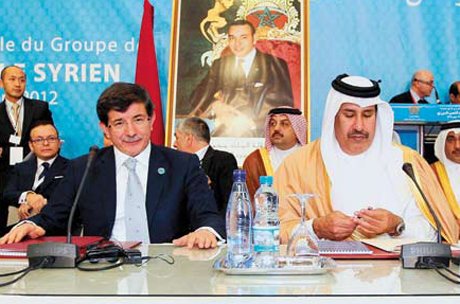
The Friends of Syrian People Group recognized Syria's new opposition coalition as “the legitimate representative of the Syrian people,” reiterating that embattled Syrian President Bashar al-Assad's regime has lost its legitimacy to govern Syria, in a meeting in Marrakech on Wednesday.
During the fourth ministerial meeting of the group, the attendees reiterated that the prompt departure of Assad would avoid the loss of more Syrian lives and further destruction.
The group also stressed that once again that the Syrian regime will not escape accountability and punishment for its violations of international law.
Syrian opposition groups, under US pressure, agreed last month to reorganize themselves under the National Coalition for Syrian Revolutionary and Opposition Forces at a meeting in Doha. Separately, opposition commanders across Syria agreed to create a united military command during a meeting last week in Antalya, while members of local administrative councils announced a joint organizational structure for local administration last week in İstanbul.
Turkey, France, Britain and Arab countries that are members of the Gulf Cooperation Council (GCC) have already recognized the coalition formed in Doha as the “sole legitimate representative of the Syrian people.”
The group also stated that the only one responsible for the violence in Syria was the Syrian regime, condemning any “terrorist acts” that undermine opposition coalition goals.
The Friends of Syrian People Group called on the Syrian regime to immediately cease its attacks and fully withdraw its troops from urban areas as the first step towards a comprehensive cessation of violence.
Referring to recent Western intelligence reports suggesting that Assad could use weapons in order to suppress the opposition forces, countries attending the meeting in Marrakech said that “any use of chemical weapons Syria will be abhorrent and that this would draw a serious response from the international community.”
While there has been intense fighting on the ground, particularly in Damascus, in the past few days, there is also growing international concern that the Syrian regime is contemplating the use of chemical weapons.
Due to these concerns, Assad has been warned that the use of chemical weapons would trigger direct military intervention against him from the West, which has so far declined to intervene in Syria's civil war.
The group also expressed their strong support for efforts to protect against the growing threat, including NATO's decision to augment Turkey's defense and allies' intent to deploy the Patriot air defense system to Turkey.
Turkey formally requested a NATO Patriot system, designed to intercept aircraft or missiles, last week amid fears that the Syrian crisis could spill over into Turkish territory.
The group also called on the UN Security Council (UNSC), to forge a “meaningful and robust” response to the 21-month-long Syrian crisis. The countries invited the international community, particularly the members of the UNSC, to increase pressure on the Syrian regime by adopting and implementing measures to prevent it from receiving external support and resources, allowing it to commit violence against its own citizens. The group stated that such measures include tightening control on the transfer of weapons used in the killing and repression of the Syrian people.
Russia and China, two faithful allies of the Syrian regime as well as two of the permanent members of the UNSC, have systematically vetoed any resolution which might pave the way for the departure of Assad.
Calling on the UNSC to assume its responsibilities, the group stated that in light of the crisis and its impact on regional security, it was critical that the UNSC exerts its substantial collective weight and influence through more efforts to solve the crisis.
The UN is facing criticism over its effectiveness and credibility as the massacres in Syria continue.
The Friends of Syrian People group also urged Assad's allies to reconsider their support and stop arms supplies. The group urged some countries supporting the Syrian regime to review its positions referring to the possibility of resorting to the UN General Assembly for the adoption of a resolution under the “union of peace” in case the UNSC fails to adopt a resolution to end the Syrian people's sufferings.
The group also expressed their commitment to providing support to the national council to coordinate the delivery of non-lethal assistance to local administrations inside Syria and technical advice and financial assistance to build the capacity of the national council in order to meet the needs of the Syrian people.
The groups also reaffirmed their commitment to facilitating a Syrian-led political solution to the crisis in Syria and expressed support for the mission of international Syria mediator Lakhdar Brahimi.
Underlining that it is for the people of Syria to determine the future of the country, the group stated that all Syrian communities should have a role in the future of Syria which should be a free, independent and democratic state.
The group encouraged the Syrian coalition and all opposition groups to work together to agree to a common approach for a sustainable transition process and the post-Assad period.
At the end of the meeting, the foreign ministers of Turkey, Canada, Egypt, Tunisia, Morocco, Qatar and the UK held a press conference and expressed their commitment to the points in the declaration. Turkish Foreign Minister Ahmet Davutoğlu reiterated three messages in the press conference. His first message was for the Syrian people, “We, the countries here, want to say that you are not alone; we understand your pain.” His second message addressed the Syrian regime, “There should be an end to operations and urgent steps should be taken.” In his third message targeting the international community, Davutoğlu urged the “UNSC to take tangible steps.” He also stated that as the Friends of Syrian People Group, “we are saying that there is an alternative to the Syrian regime. We need to strengthen the Syrian coalition.”
In addition, Davutoğlu had bilateral meetings with his Egyptian, Qatari and British counterparts, Mohamed Kamel Amr Sheikh Hamad bin Jassim bin Jabor Al Thani and William Hague respectively.
On the eve of the meeting in Marrakech, President Barack Obama granted US recognition on Tuesday to a Syrian opposition coalition as the legitimate representative of the Syrian people, a move aimed at ratcheting up pressure on Assad to leave power.
Obama announced his decision in an interview with ABC News, but he stopped short of authorizing US arming of rebels fighting to overthrow Assad.
“It's a big step,” Obama said in a step that could provide a diplomatic boost to the anti-Assad political cause after nearly two years of fighting
Prior to the meeting in Marrakesh, the third meeting of the Friends of Syria group was held in French capital, Paris, where delegations from the US, European and Arab countries as well as Turkey attended. The group first met in Tunisia in February, while the second gathering, attended by representatives from about 80 countries, was in İstanbul in April.
The participants welcomed Italy's readiness to host the fifth Ministerial meeting of Friends of Syrian People in 2013.
‘Friends of Syria' recognizes new Syrian coalition
The Friends of Syrian People Group recognized Syria's new opposition coalition as “the legitimate representative of the Syrian people,” reiterating that embattled Syrian President Bashar al-Assad's regime has lost its legitimacy to govern Syria, in a meeting in Marrakech on Wednesday.