

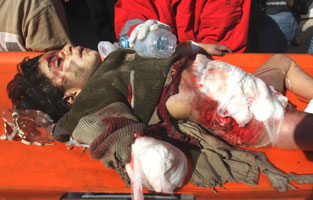
The violence defied a new call from the UN chief to immediately end fighting in Gaza.
Israel showed no signs of slowing its brutal 19-day-old offensive against Gaza's Hamas rulers, striking some 60 targets. One air strike hit an overcrowded cemetery, spreading body parts and rotting flesh over a wide area. The army said the air strike targeted a weapons cache hidden near the graveyard. The rocket fire in the north caused no injuries, but sent residents scurrying to bomb shelters. There was no immediate claim of responsibility. Hezbullah, which fought a month-long war with Israel in 2006, denied involvement in last week's attack, and speculation focused on small Palestinian groups.
Lebanese security officials said the Israeli army fired at least eight artillery shells on south Lebanon in response. The Israeli military said it targeted the source of fire, and that it regarded the Lebanese government and military responsible for preventing attacks on Israel. The government of Lebanese Prime Minister Fuad Saniora condemned the attack.
|

Israel repeatedly has said it does not seek renewed fighting with Lebanon, but is prepared for hostilities along the northern border. The Muslim world has expressed outrage over Israel's Gaza offensive, and in a new condemnation on Wednesday, al-Qaeda leader Osama bin Laden urged Muslims to launch a holy war against Israel. Iran's top leader, Ayatollah Ali Khamenei, issued a religious opinion, or fatwa, declaring the purchase of any Israeli goods or trade with Israeli companies to be forbidden. Israel launched the onslaught in Gaza on Dec. 27, seeking to punish the ruling Hamas militant group for years of rocket attacks on southern Israel. The offensive has killed over 1,000 Palestinians, half of them civilians, according to Palestinian hospital officials. The toll included 11 Palestinians killed Wednesday, medical officials said.
Thirteen Israelis have also been killed since the offensive began, four by rocket fire from Gaza. Desperately trying to end the fighting, UN secretary-general Ban Ki-moon opened a visit to the Mideast on Wednesday urging an immediate halt to the violence.
"My call is (for) an immediate end to violence in Gaza," he said in Cairo after meeting Egyptian President Hosni Mubarak.
"It is intolerable that civilians bear the brunt of this conflict," he said, adding that the "negotiations need to be intensified to provide arrangements and guarantees in order to sustain an endurable cease-fire and calm." Ban is scheduled to arrive in Israel on Thursday.
Israel is trying to keep up the pressure on Hamas to accept Israel's truce terms: A complete cessation of violence from Gaza and international guarantees of a halt in the smuggling of weapons into Gaza through the porous Egyptian border.
Overnight, Israeli warplanes and helicopter gunships pounded a police court in Gaza City, rocket-launching sites, gunmen, weapons-production and storage facilities and about 35 weapons smuggling tunnels, the military said. Later in the day, witnesses in southern Gaza reported air strikes on the house of a rocket squad leader and a militant's car.
Aircraft also struck the Sheikh Radwan cemetery in Gaza City, destroying about 30 graves -- some just recently dug -- and scattering bits of flesh and body parts for meters, residents said. The stench of scorched and rotting flesh hung over the area.
Maj. Avital Leibovich, a military spokeswoman, said the army targeted a weapons cache next to the cemetery and a nearby rocket-launching site. She said the heavy damage was the result of secondary explosions. Israel has repeatedly accused Hamas of using mosques, schools and other civilian areas to stage attacks or store weapons.
Witnesses described a gruesome scene of strewn body parts and the stench of charred and rotting flesh.
"There was flesh on the roofs, there was small bits of intestines. My neighbor found a hand of a woman who died a long time ago, we put it all into a plastic bag," said resident Ahmad Abu Jarbou. "One man who buried his cousin yesterday couldn't find the body at all."
In other fighting, artillery units fired shells that spread white clouds of smoke that hung above the city center, witnesses said. Human Rights Watch has accused Israel of using phosphorous shells -- a weapon that can burn anything it touches. The Israeli military has not confirmed reports that it has improperly used white phosphorous shells, saying only that it uses munitions is in accordance with international law. The International Committee of the Red Cross urged Israel to exercise "extreme caution" in using the incendiary agent, which is used to illuminate targets at night or create a smoke screen for day attacks, said Peter Herby, the head of the organization's mines-arms unit.


