

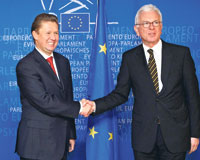
The Russian state gas monopoly stopped all natural gas shipments through Ukraine on Wednesday, cutting off more than a dozen European customers further west, amid a pricing dispute with Kiev. Russia had insisted its representatives be included in the EU monitoring mission, and Ukraine agreed on Friday, according to an EU statement. " It is now imperative that the gas starts to flow," the EU said.
Miller pledged Gazprom would start pumping gas to Europe again once the monitors were in place at pumping stations across Ukraine -- a country roughly the size of South Africa or Texas. But as Russian and Ukrainian officials traded new accusations Friday, doubts emerged about whether the monitoring deal could be inked quickly. Miller accused Ukraine of creating obstacles to the deal, saying: " Ukraine is afraid of creating such a [monitoring] mechanism. If it's created, our Ukrainian colleagues will have to work in an open and transparent way, and they very much dislike it," Miller said during a meeting with Russian President Dmitry Medvedev in the southern Russian city of Sochi.
Ukraine's state company Naftogaz spokesman Valentyn Zemlyansky said Russia was the one dragging its feet on the deal. " They are just wasting time, trying to make this process as long as possible," Zemlyansky told the AP. Once it restarts the gas flow, it could take up to a day for supplies to reach Europe, Gazprom has said. The halt in gas supplies has left European nations struggling to cope during a harsh winter. At least 11 people have frozen to death this week in Europe, including 10 in Poland, where temperatures have sunk to -25 degrees Celsius.
Fifteen countries -- Austria, Bulgaria, Bosnia, Croatia, the Czech Republic, France, Greece, Hungary, Italy, Macedonia, Romania, Serbia, Slovakia, Slovenia and Turkey -- said their Russian supplies ceased Wednesday. Germany and Poland also reported substantial drops in supplies.
EU governments have criticized both Russia and Ukraine for the gas crisis, saying it was unacceptable to see homes unheated, businesses closing and schools shut down in the middle of winter because neither Russia nor Ukraine could stick to its supply contracts. The two former Soviet republic countries are locked in tense negotiations over future prices and debt. The EU monitoring team arriving Friday in Kiev will tour gas pumping stations along with Russian experts, said Valentyn Zemlyansky, spokesman for Ukraine's state gas company Naftogaz.
The announcement of resumption of gas supplies to Turkey through Ukraine came just hours after Turkey and Iran announced the completion of negotiations to almost double the flow of gas to Turkey from Iran. The deal will bring the total flow of gas from Iran up to about the 30 million cubic meters per day.
Meanwhile, Serbs have burned a Russian flag to protest a lack of heating caused by Moscow's halting of gas supplies through Ukrainian pipelines, according to a newspaper Friday. The protest in the central town of Kragujevac, reported by the Blic newspaper, was unusual, as Russia is considered Serbia's traditional Orthodox Christian ally. The situation has highlighted in the minds of many the need to diversify gas sources. Speaking before the European Commission, Hungarian President Ferenc Gyurcsany called on the EU to work toward lifting the " energy Iron Curtain" and called on the EU to assist in the realization of the Nabucco pipeline, which will bypass Russia and bring Caspian natural gas through Erzurum in Turkey, continuing through Bulgaria, Romania, Hungary and Austria.
Even leading European countries such as Italy have been questioning their dependence on Russian gas. Italian newspaper Corriere della Sera asked yesterday: " How can the seventh or eighth economic power in the world -- which, despite everything, Italy still is -- periodically be in a state of emergency as regards gas supplies? The umpteenth 'crisis' presents once more a similar imperative: that of freeing ourselves from gas weakness and reducing our dependency on Moscow."


