

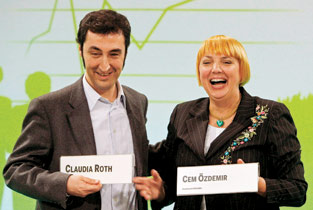
"No matter your background, if your forefathers are from Kazakhstan, from Anatolia or if they fought against the Romans at Teutoburg Forest, all are equally important," he said, citing the legendary battle in A.D. 9 where Germanic tribes massacred three Roman legions.
Özdemir's election as the Greens co-leader has come amid the global euphoria over the victory of Barack Obama and has led to parallels between the two in Turkey. " Is he the Barack Obama of Germany?" asked daily Hürriyet on its front page. On a continent that has struggled to produce leaders from minority communities even as it celebrates the triumph of Obama in the United States, Özdemir stands out as a rare politician who has broken racial barriers to win national prominence.
There are some 2.7 million ethnic Turks in Germany, the country's largest minority, representing about 3.3 percent of the population. But while relations between Germans and Turks are generally civil, only five German Turks serve in Parliament and none have joined their party's leadership or Cabinet. And although the Turks have found success in independent businesses and the arts, they have little presence in the management of major German companies.
Özdemir's career track has drawn parallels in Germany to that of Obama -- so much so that when Özdemir decided to run for the Greens leadership, his staff started a Facebook group called " Yes we Cem" -- a play on Obama's " Yes we can" slogan.
Like Obama, Özdemir enjoys a reputation as a pragmatist and has written books about his experience as an outsider. Asked by a delegate after his speech what could be learned from Obama's election, Özdemir said, " Courage, opportunities and that we must make sure nobody is left behind; that is my lesson from the American election."
" I want to represent primarily the people who are left outside," he told the Anatolia news agency in an interview after his election. But he made clear his ethnic roots should not be seen as important. " What matters for me is not that I was elected as a Turk, but that my ethnic roots as a Turk do not carry significance," he said. " I am not for the election of a person just because of their ethnic origin. A person should be able to get elected to a post no matter what their origin is."
Özdemir and Roth take their posts before next year's national elections, with the Greens polling behind the other two major opposition parties -- the Free Democrats and the Left Party.
But the Green Party remains influential in Germany, and for seven years until 2005 was the junior member of former Chancellor Gerhard Schröder's coalition government.
The Greens could find themselves back in power again next year, as neither of the two biggest parties -- the Social Democrats and Chancellor Angela Merkel's Christian Democrats -- looks likely to win enough support to form a government on its own. The two currently govern together in a " grand coalition."
On Saturday, the Greens approved a program dubbed a " green New Deal" envisioning more state regulation, with economic growth bound closely to environmental and social welfare policies.
Özdemir reminded the convention that, when in power, the Greens pushed through Germany's plan to phase out nuclear power, increased the use of renewable resources and toughened consumer protection regulations. " We had seven successful years," he said. Born to Turkish Muslim parents in Swabia, Özdemir's rise in German politics began in 1994 when he became the first ethnic Turk to win a seat in parliament, just two years after he gained German citizenship. In 2004 he won a seat in the European Parliament in Brussels.
Özdemir's Turkish parents emigrated in the early 1960s, looking for good wages and planning to return to Turkey. They stayed, as did many Turkish " guest workers" who came to work in West German coalmines and steel mills. They fueled an economic revival after World War II and are now Germany's largest minority.
In his youth, Özdemir learned two dialects of German as well as English, while growing up in a Turkish-speaking household. While attending college, he trained as a social worker. In the Bundestag, Germany's lower house of parliament, he quickly earned a reputation as a charismatic advocate for environmental protection and better education for the working class. He is now married to an Argentinean journalist and has a young daughter.


