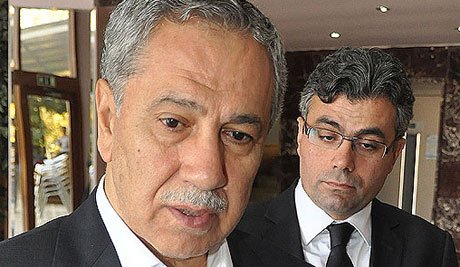
Deputy Prime Minister Bülent Arınç has said he was very pleased to hear that hundreds of inmates who have been on a hunger strike for the past 68 days have ended their protest, speaking to reporters on Sunday.
Hundreds of Kurdish inmates ended a hunger strike in jails across Turkey on Sunday after an appeal from their leader, fuelling hopes a deal had been struck that could revive talks to end a decades-old conflict.
The jailed leader of the terrorist Kurdistan Workers' Party (PKK) Abdullah Öcalan on Saturday called on his supporters to end their protest after holding a series of talks with officials from Turkey's National Intelligence Organization (MİT), claimed the Radikal daily on Sunday without naming its sources. MİT officials and PKK leaders have held talks before in the Norwegian capital of Oslo.
Öcalan's call for an end to the hunger strike, which militants staged to demand an end to his isolation in an island prison south of İstanbul, was announced by his brother on Saturday. The protestors also demand the right to have Kurdish be declared an official language that can be used in court proceedings as well as the right to education in one's mother tongue. The striking inmates, most of whom are convicted or are facing charges of, membership in the PKK or the Kurdistan Communities Union (KCK), an illegal umbrella organization that includes the PKK.
“On the basis of our leader's call ... we end our protest as of Nov. 18, 2012,” Deniz Kaya, a spokesman for the protestors, was quoted as saying in a statement by the Union of Families of Detained and Imprisoned Persons (TUHAD-FED), an association representing the inmates' families.
Deputy Prime Minister Arınç welcomed the news on Sunday, saying “We know that in many prisons some convicts and some in custody have been on a hunger strike and some on a death fast. We have appealed to the inmates to give up. We told them that their health and livelihood is important to us. We said their demands could always be talked about in Turkey.” He also said he wanted to thank the inmates for their decision to end the protest adding that he hoped such a protest would not be repeated.
Last week, Peace and Democracy Party (BDP) deputies also started a hunger strike. Arınç said by ending the strikes, the protestors showed that they refused to be used as an instrument for the political interests of others. BDP Deputy Chairwoman Gültan Kışanak, who made a press statement outside Diyarbakir Prison, said she had visited some of the inmates of the prison. “They told us that they are ending the hunger strike today,” said Kışanak adding that there were some protestors whose health was deteriorating.
Another spokesperson for the BDP said there were plans to hospitalize 81 inmates in Diyarbakır, while health experts on Sunday were conducting medical examinations of the prisoners. Reports from various provinces indicated that medical checks were conducted in all of the prisons where the hunger strikes had come to an end. No striker was reported as being in critical condition.
BDP Chairman Selahattin Demirtaş, who was in Muş on Sunday, said he was happy about the strikes ending without any deaths. He said only politics can solve the Kurdish issue after this point. “Let's solve issues with politics without the need for guns, death, blood or tears. Our call is a clear one. Let's sit down and talk and we certainly will find a point of consensus.” He said the government should handle the issue delicately now. “Such a valuable period that can serve as a crucial period for solution should not be used poorly,” he said. He said the hunger strikes had opened a very important period, a new era.
Demands of the strikers
Although there were reports of some sort of an agreement between Öcalan and the MİT, there was no indication the hunger strikers' demands had been met. As well as end to Öcalan's isolation and limited access to lawyers, the inmates had demanded greater use of the Kurdish language in schools and other institutions. The Justice and Development Party (AK Party) under the leadership of Prime Minister Recep Tayyip Erdoğan has boosted Kurdish cultural and language rights since taking power a decade ago. But Kurdish politicians are seeking greater political reforms, including steps towards autonomy for mainly Kurdish southeastern Turkey.
Addressing one of the protesters' demands, the government has submitted to Parliament a bill allowing defendants to use Kurdish in court testimony. A total of seven leading Kurdish politicians, mostly from the pro-Kurdish BDP, joined the hunger strike over the last week. "We hope this call will pave the way for the next process, which is to end [Öcalan's] isolation ... The Kurdish problem should be resolved by dialogue and deliberation," BDP leader Demirtaş told reporters late on Saturday.
Öcalan's solitary confinement was eased in 2009 when five more inmates were brought to the island. His current situation is unclear but lawyers say he has no access to a telephone or television and his newspapers are censored. His lawyers say authorities have declined their requests to visit Öcalan 134 times since they last saw him on July 27, 2011, usually blaming bad weather or breakdowns on the boat that would ferry them to İmralı Island where he is being held.
Fighting between the PKK and Turkish forces surged over the summer. Ankara has linked the renewed hostilities to the conflict in neighboring Syria and accused Syrian President Bashar al-Assad of arming the PKK. More than 40,000 people have been killed in 28 years of fighting between Turkey and the PKK -- designated a terrorist group by Ankara, the United States and the European Union.
Government welcomes end to hunger strikes in prisons
Deputy Prime Minister Bülent Arınç has said he was very pleased to hear that hundreds of inmates who have been on a hunger strike for the past 68 days have ended their protest, speaking to reporters on Sunday.