

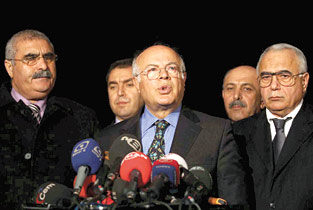
Erdoğan had talks with Cem Foundation President İzzettin Doğan, Alevi İslamic Religious Services Association President Ali Rıza Uğurlu, Alevi Foundations' Federation President Doğan Bermek and Cem Foundation General Manager Hadır Akbayır at the Dolmabahçe Palace in İstanbul. Justice and Development Party (AK Party) deputy Reha Çamuroğlu and state ministers Mehmet Aydın and Said Yazıcıoğlu also participated in the talks, which lasted for two hours on Saturday.
Cem Foundation President Doğan expressed his foundation's demand that Alevi dedes -- Alevi spiritual and community leaders -- be paid the regular salaries given to imams by the Religious Affairs Directorate. He also asked for representation in the Religious Affairs Directorate based on the demographic intensity of Alevis in Turkey.
Yazıcıoğlu replied, " If 98 percent of Alevis agree with you, we can solve this problem easily," according to Doğan, who briefed the press after the meeting. Yazıcıoğlu also spoke to reporters after the meeting, referring to the talks as " extremely balanced and positive" and adding that the government wants to prevent the Alevi question from being exploited politically.
In his press briefing on the Dolmabahçe summit, Doğan said the legal actions necessary to meet Alevi demands would be taken after the local elections in March of next year so that the general public will understand that the initiative is not a political ploy by the government. Doğan also expressed his view that the rights of Alevis can be granted without causing bitterness in other segments of society.
Doğan stated that Alevi leaders, Prime Minister Erdoğan and the senior members of his party spoke comprehensively about the teachings of Alevi Islam. He said community representatives also requested that a part of the general budget be allocated for the Alevi population. In response to a question from the press regarding some Alevi groups' opposition to putting Alevi dedes on the state payroll, Doğan said the opponents represent only 1 percent of the Alevi community, adding that these groups support an Alevism outside of Islam. " Go ask the dedes and see if you can find one who is against it. Ninety-eight percent of the Alevi community thinks like us on the salary issue."
Another request the representatives brought forward during the meeting was the recognition of the Alevi perspective of Islam by the Religious Affairs Directorate. Doğan also cited another demand, saying, " State radio and television broadcasts should include programs targeting Alevi citizens."
The representatives and government leaders also talked about possible conflicts that might arise when Alevis are given specific rights by the government. Doğan said: " Why should there be conflict when Alevis are given their rights when there has been no conflict when their rights were not granted? We discussed this in earnest. Our understanding is that the government would like to introduce solutions to problems." He said the issue of granting cemevis -- Alevi community and worship centers -- the status of places of worship had also been discussed, but said no agreement had been reached regarding that point. " We simply had an exchange of opinions. The question of legal status will be taken up again in the upcoming meetings," Doğan said, noting that the parties had also agreed to have further talks.
He stated that they had decided to continue planning and preparing the necessary infrastructure for new legislation before next year's elections, after which the points agreed upon during the meetings would be put into effect. " They did not make any promises that gave us the impression that they see this only as an investment for the elections. This was a meeting between civil society organizations and political leaders," he said. Doğan also said the number of Alevis in Turkey is somewhere between 25 and 30 million.
'Not a political investment for government'
In his statement on the meeting, Yazıcıoğlu said the meeting had been " balanced, mature and very positive." Emphasizing that the issue was not an election strategy for the government, Yazıcıoğlu underlined that the government wished to prevent political exploitation of the issue. Although he avoided commenting on the possibility of placing Alevi dedes on the Religious Affairs Directorate's payroll, Yazıcıoğlu said, " We made an evaluation on the methods of how the state can include every segment of society."
Meanwhile, speaking at a press conference he held at the Hacı Bektaş Veli Anatolia Culture Foundation on Sunday, Alevi Bektaşi Federation President Ali Balkız said Alevis love their country like everyone else who lives in Turkey and have fulfilled their obligations as citizens, adding that they would like to have equal access to opportunities provided by the state. " But we are being denied this. We are unhappy about this; we are not equal; we are like stepchildren," he told the press.
" In this struggle, we do not discuss whether Alevism is a part of Islam or if it's not. We are speaking about the problems of Alevis. Government representatives have made this distinction of those who see Alevism as part of Islam and those who see it as outside Islam. We do not accept the classification that those who see Alevism as part of Islam will go to heaven and those who do not will not," he said. He also said the existence of the Religious Affairs Directorate and obligatory religion classes at schools contradicted the principle of secularism.


