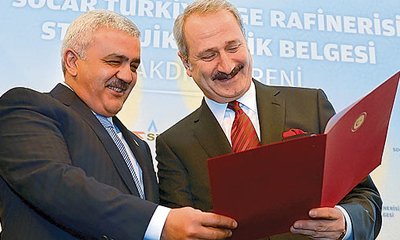
A new government investment incentive program has seen the number of firms to receive tax breaks and other subsidies from the government increase nearly a quarter between July and November compared with the same period last year, Economy Minister Zafer Çağlayan said over the weekend.
“It indeed shows that our [investment] inflow has been prodigious under this incentive system, and it will be even better in the coming years,” Çağlayan asserted as he spoke of the influx of foreign and domestic capital under the incentive law, which came into force in June. This law divides the country's provinces into six categories based on their level of development and gives progressively more generous subsidies and tax breaks to companies investing in less-developed regions.
“We've seen an increase to TL 22.8 billion ($12.7 billion) in total investment between July and November,” Çağlayan told members of the press over the weekend, estimating that the number of jobs to be created by the proposed investments over that period hovers at around 78,000. The economy minister said that the bulk of the investment would be spent in three categories: TL 11.5 billion will go to manufacturing, TL 7 billion to the services and food industry and TL 3.9 billion to energy.
The minister also said that the pace of investment had quickened compared to when the package was first made law in June, with “the month of November securing TL 5.7 billion in contracts … a 31 percent increase over that month last year.” The November numbers gained slightly on September's record investment haul of TL 5.1 billion ($2.85 billion), and both months saw significantly more investment than the first four months of the package, which cumulatively saw investment reach TL 10.75 billion ($6 billion).
The growth of investments -- and the hefty amount of private investment in manufacturing -- is likely to make Ankara smile as it seeks to boost its domestic manufacturing base and become a production hub for Africa, Europe and the Middle East. Despite a years-long downturn in Europe, Turkey's key market for manufactured exports, manufactured exports have nevertheless grown by 5 percent this year, a report published by the International Monetary Fund (IMF) stated this week.
As well as increasing the absolute volume of investments, the program is designed to attract new investments to 15 of the country's least-developed regions, which have been neglected for decades under centrally planned economic programs that favored Turkey's west over the east.
The package is nonetheless not the first eastern-province-centered development package put forth by Ankara, and last week beneficiaries of an older incentive law complained of being “locked out” of the newer package. Incentive Law 5084, a four-year-old incentive package that pays subsidies to companies moving from the west to the east, will end in January when, according to several eastern business associations, roughly 700 firms will lose government aid provided by the law. Firms complain that the new law gives tax breaks for firms moving east under the new plan, not those who moved under the old, warning that labor costs for previous beneficiaries may double when subsidies end.
The government's willingness to forsake billions of dollars in annual taxes under the plan comes as it seeks to bolster the economic stability of the country's far eastern provinces, where conflict between the government and the terrorist Kurdistan Workers' Party (PKK), as well as a stalled Kurdish initiative by the government, have long prevented sizeable investment.
Gov't incentive program sees investment up a quarter
A new government investment incentive program has seen the number of firms to receive tax breaks and other subsidies from the government increase nearly a quarter between July and November compared with the same period last year, Economy Minister Zafer Çağlayan said over the weekend.