

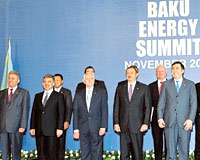
" Energy safety requires development of cooperation among energy producing, consuming and transporting countries, and we should turn our mutual independence in energy projects, like the Baku-Tbilisi-Ceyhan [BTC] pipeline, into a lucrative cooperation that brings together regional powers, large companies and major players," Gül explained. Referring to August's crisis in Georgia, he said the clash once again confirmed that unresolved regional disputes posed a threat for security and stability in the Caucasus. He noted that such disputes should also be resolved for the sake of energy security in Eurasia. " The safe transportation of Caspian energy resources to European markets depends on the maintenance of regional stability and the establishment of good neighborly relations," he added.
Gül argued that current tensions could be resolved by building mutual confidence among nations in the southern Caucasus. The Turkish president referred to Turkey's proposal to set up a stability and cooperation platform for the region and said Ankara's aim was to make the south Caucasus a model of unity and solidarity among neighboring countries. Turkey also hopes to make the region an area of prosperity, stability and peace that can contribute to Europe's energy security, Gül said. " We are determined to cooperate with neighboring countries to achieve this goal," Gül explained. He said Turkey had developed an east-west energy corridor with Azerbaijan, Georgia and the United States because it was situated in a region that possessed around two-thirds of the world's oil and gas reserves. The Turkish president said this energy corridor consisted of the BTC oil pipeline and the Baku-Tbilisi-Erzurum (BTE) natural gas pipeline. Over 480 million barrels of crude oil had been transported to consumer countries through the BTC pipeline as of Nov. 10, he added.


