

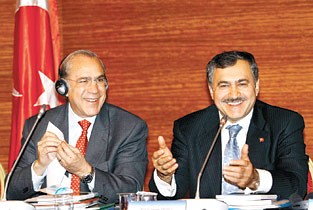
The statement made in Ankara during a press conference with Turkish Finance Minister Kemal Unakıtan comes at a time when an increasing number of observers are arguing that Turkey needs to sign a new International Monetary Fund (IMF) stand-by agreement.
"The growth rates of OECD countries will generally decrease in 2009; however, Turkey will display a successful performance among such countries" said Gurria, addressing an audience in Ankara on Monday. Confirming the suspicions of the latest OECD report, he continued by saying, that "Turkey will be affected by the crisis in three ways: economic activities will slow down, unemployment will increase and growth will decline to around 1 percent."
Monday's announcement by TurkStat that Turkish growth had slowed to a 0.5 percent crawl in the third quarter when compared to the same period last year and that unemployment had risen to 10.3 percent came on the heels of startling figures released last week that the industrial output index had dropped by 9.7 percent compared to the same month last year.
In a press statement after the meeting, Unakitan said: " Turkey was prepared when the crisis emerged. We had already carried out many structural reforms and taken plenty of measures."
Since the crisis emerged, many have claimed that Turkey is poised to whether the crisis better than most as a result of the country's strong experience with crises over the years and the government's implementation of a host of structural and banking reforms in the aftermath of the 2000 and 2001 financial crises.
And not all were as optimistic as Guirra and the Turkish party line. The latest TurkStat figures have fed fears elsewhere in the world about the Turkish economy. The Wall Street Journal reported yesterday that Turkey risked recession in 2009, citing TurkStat's latest figures and saying that growth would likely be negative in the first quarter.
The Financial Times, commenting on the latest TurkStat figures, affirmed the view that the Turkish economy was poised for recession and rejected the statements of Turkish politicians who have been repeating that Turkey will feel the impact of the crisis to a minimal extent. The fact that Turkish quarterly growth rates were the worst in six years was further testament, the Financial Times wrote, that the government should sign a new stand-by agreement with the IMF without haste.
Increasingly, there has been an emerging polarization between observers over how the government should respond. Most international observers have been pointing to the abovementioned indicators as evidence that the government needs to sign a new stand-by agreement.
Domestic observers remain divided, however, with an ever-increasing number pointing to the latest TurkStat figures as evidence of a growing need for the government to increase public spending as a means to spur growth in the non-financial economy. They point to the 8 percent growth the banking sector but the forecasted negative growth in the non-financial sector as evidence that it's not the financial sector that needs support.
Recently Turkish Confederation of Businessmen and Industrialists (TUSKON) Chairman Rızanur Meral called on the government to support " investments that would create value-added benefits for local enterprises like transportation and infrastructure must be supported."
DenizBank chief economist Dr. Saruhan Özel has also been vocally advocating government public spending and warning against a new IMF stand-by agreement, which would hamper the state's ability to respond to the crisis. Speaking to Today's Zaman, Özel dismissed common arguments that municipal elections could lead to populist spending and said that these assertions are " purely ideological." " Of course spending will be in the municipalities; this is where public sector spending is carried out. How can we say this is bad? This is where jobs are created, infrastructure is built and growth is promoted," he said.
Public spending and growth forecasts remain some of the biggest hang-ups in negotiations between the government and the IMF, with the latter arguing that growth forecasts should be brought down from 4 percent to 2 percent and that public spending and other inflationary policies need to be discouraged to focus on fiscal austerity.
The upcoming elections and the populist economic legacy of previous governments in the run-up to elections have been among the key fears of the international finance community and proponents of the IMF stand-by agreement, such as the IMF.


