

A spokesman for Israeli Prime Minister Ehud Olmert said earlier that if a cease-fire held in the Hamas-ruled enclave, Israel could start the process of withdrawing its forces.
" Hamas and the factions announce a cease-fire in Gaza starting immediately and give Israel a week to withdraw," said Ayman Taha, a Hamas official in Cairo for talks with Egypt on a truce deal.
The Hamas movement said previously it would not stop its attacks as long as Israeli soldiers remained in the Gaza Strip.
Taha said Hamas was demanding the opening of all Gaza border crossings for the entry of " all materials, food, goods and basic needs." Israel tightened its blockade of the Gaza Strip after Hamas seized the territory from forces loyal to Palestinian President Mahmoud Abbas in 2007.
Just hours earlier, rockets from the Gaza Strip hit southern Israel in defiance of the unilateral cease-fire that Olmert declared late on Saturday and which went into effect at 2 a.m. (0000 GMT) on Sunday.
Olmert said Israel would not bring its troops home until Hamas ceased fire completely and he threatened its military would respond strongly to any attacks on the soldiers or cross-border rocket salvoes.
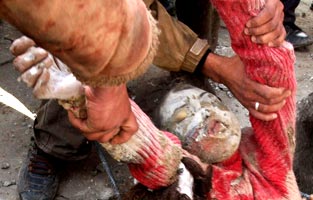
Palestinians rushed to remove bodies from rubble and survey damage to homes damaged or destroyed since Israel launched on Dec. 27 its most powerful offensive in the enclave in decades.
Leaders from Britain, Egypt, France, Germany, Italy and Turkey and UN Secretary-General Ban Ki-moon were meeting in the Egyptian Red Sea resort of Sharm el-Sheikh to coordinate policy on the Israeli-Palestinian conflict.
" Israel must allow full access to humanitarian workers, and to relief supplies," British Prime Minister Gordon Brown told reporters en route to the summit. " We must also end Gaza's economic isolation by reopening the crossings that link it to the outside world."
Egypt said the gathering would try to help it turn the cease-fire Israel declared into a mutual agreement leading to Israeli withdrawal from the Hamas-ruled Gaza Strip.
During the 22-day-long offensive, Israeli attacks killed more than 1,300 Palestinians, including some 700 civilians, Gaza medical officials said, and well over 5,000 were wounded. Only Ten Israeli soldiers were killed as well as three Israeli civilians hit by rockets.
The mounting civilian death toll in the Gaza Strip and mounting destruction and hardship in the territory brought strong international pressure on Israel to stop the brutal offensive.
Rockets
Hours after the Israeli cease-fire began, five rockets were fired from Gaza into the Israeli town of Sderot, causing no casualties, an Israeli military spokesman said. By the afternoon, another nine rockets hit Israel, police said.
Israeli aircraft staged what appeared to be a limited response, attacking sites where the rockets were launched. In the first reported fatality since the cease-fire began, a Palestinian was killed by Israeli forces near the town of Khan Younis after mortar bombs were fired from the area, medical workers said. They identified him as a civilian.
In an address late on Saturday, Olmert claimed the Israeli operation launched with the declared aim of ending cross-border rocket attacks that had killed only18 people in Israel over the previous eight years, had achieved all its objectives.
Olmert cited internationally backed understandings with Egypt, Gaza's southern neighbor, on preventing Hamas from rearming through smuggling tunnels as a reason behind Israel's decision to call off its attacks.
Left unsettled was an issue at the heart of the conflict -- Israel's blockade of the Gaza Strip. Hamas, though hit hard by the air and ground campaign, remains the de facto force within the coastal enclave.
Without an accord with Hamas, diplomats said they feared Israel would let only a trickle of goods into Gaza, hampering reconstruction and creating more hardship for its people.
Olmert, speaking about Sunday's rocket attacks, told his cabinet that Israel was reassessing the cease-fire constantly and troops were " prepared to act in any area" if " violations such as those that occurred this morning continue."
Palestinian ambulances picked up more than 95 bodies that had lain in the rubble of buildings and open areas in and around Beit Lahiya, Hamas police and health officials said.
Residents who had left during the fighting returned to survey what remained of their homes. Children picked through the debris to uncover school bags and torn books.
A column of Israeli tanks and soldiers, some holding Israeli flags, withdrew from the Gaza Strip for what the army called " rest and relaxation."
But several of the tanks established a position 100 meters inside Gaza while others remained deployed on the eastern edge of the city of Gaza.
Israeli forces reopened the main north-south Gaza road, which they had closed during the conflict, but witnesses said tanks were still stationed along the route.


