

An Israeli offensive in Gaza began on Dec. 27 amid scattered firings of homemade Palestinian rockets eight days after the six-month truce between Israel and Hamas expired. The offensive came on top of an Israeli blockade of Gaza that has largely kept all but essential goods from entering the coastal territory since Hamas seized control in June 2007. Hamas had said at the time that the truce, which went into effect in June 2008, was valid for six months.
Since it began, Israel's Gaza campaign has killed more than 900 Palestinians, about half of them civilians, according to Palestinian medical officials. Thirteen Israelis, including 10 soldiers, have been killed.
Egypt had played an important role in maintenance of last year's truce between Israel and Hamas. However, in recent times, the relationship between Egypt and Hamas has been so strained that it was on the verge of collapsing. With Turkey's timely interference, Hamas has continued negotiations for a cease-fire.
Pro-US Arab countries -- Egypt, in particular -- have come under heavy criticism in widespread street protests, as well as from Iran, Hamas and the Lebanese militant group Hezbullah, for allegedly not doing enough to stop Israel or help Gazans. Officials and pro-government media in Egypt and Saudi Arabia have responded by blaming Hamas for provoking Israel and accusing the group of being a proxy promoting the power of regional rival Iran.
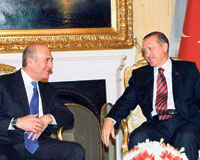
The Turkish government decided to intervene in the issue, and a Turkish delegation led by Prime Minister Recep Tayyip Erdoğan flew to Cairo on the first day of the new year as part of a regional tour aimed at uniting countries in the region to push Israel to halt its ongoing attacks on the Gaza Strip, senior sources, speaking on condition of anonymity, said.
In Cairo, the Turkish delegation observed that the Egyptians and Hamas were no longer able to talk to each other due to a mutual loss of trust. " You can still play the leading role in cease-fire efforts; it doesn't matter to us. But let us help because the situation is worsening," Turkish officials told their counterparts then, as Ankara prefers that Egypt be the leading country in these efforts both due its experience and due to the fact that it has a border with Gaza.
" Turkey is involved but is not visible. It will continue like this for a while," the same senior sources said.
Last week, Egypt delivered a document to Hamas regarding cease-fire conditions. However, they were unable to talk to Hamas leaders concerning content of the paper. Upon this development, Egyptian President Hosni Mubarak called Erdoğan on Friday and asked him to send a special envoy to Egypt to join the ongoing cease-fire negotiations between officials from Egypt, the Palestinian Authority and Hamas. Upon Mubarak's request, Erdoğan ordered that a delegation led by his top foreign policy advisor, Ahmet Davutoğlu, and including officials from the Prime Ministry and the Foreign Ministry travel to Egypt.
Davutoğlu met with exiled Hamas leader Khaled Mashaal in Damascus on Monday following meetings with the Egyptians. Davutoğlu had played a center role in Turkish-mediated indirect talks between Israel and Syria last year. Within days of the launch of Israel's offensive, Turkey had announced that it had suspended efforts to broker peace talks between Israel and Syria, saying the onslaught in Gaza had led to " deep disappointment" in Ankara.
Turkish officials, speaking with Today's Zaman, have voiced awareness of Egypt's approach toward Hamas. According to the same officials, Egypt does not consider Hamas a " brother," on the contrary, it considers the group a " threat against its own regime."
Babacan to Livni: Do not come to Ankara for show
Last week, a leading Israeli daily suggested that Turkish officials recently rejected a request by Israeli Foreign Minister Tzipi Livni to visit Ankara following harsh remarks by Prime Minister Erdoğan vis-à-vis Israel's deadly offensive in Gaza.
" Our door is open if you want to come. But if you're coming just to show that everything is OK with Turkey, then don't. Let's talk cease-fire conditions when you come. If you feel ready to do so, then you should come," Foreign Minister Ali Babacan told Livni then, Today's Zaman learned from reliable sources.
SERVET YANATMA PRISTINA


