

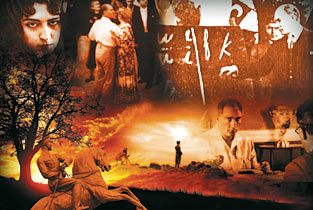
" Why is he shown like that, in front of a steppe? His head is down as if he is apologizing for something. And those words, which were originally removed from an address of his, have now re-emerged. I find it disrespectful," said a 48-year-old doctor who says she thinks highly of Atatürk, who became legendary among Turks for his stance against the country's foreign enemies in World War I.
Originally a military commander, he became a civilian leader to carry his occupied nation to liberation. He founded the Republic of Turkey in 1923 from the ashes of the Ottoman Empire as a European-style secular democracy, and in the process he abolished the Ottoman caliphate, replaced Arabic script with the Latin alphabet, introduced a Western-style dress code banning the fez and the veiling of women, modeled the Turkish penal system after the Italian Penal Code, closed Islamic courts and enfranchised women in the predominantly Muslim country.
Highly regarded journalist-documentary maker Can Dündar's biographical documentary " Mustafa" received both the best and worst reviews from viewers and commentators in Turkey, where insulting Atatürk is a crime. Atatürk is given an almost untouchable status, and his reforms are enshrined as " Kemalist ideals." Some ultranationalists have even criticized Dündar for using a local Greek boy in the scenes depicting Mustafa the child when he was filming in Atatürk's hometown Thessaloniki.
Based on Atatürk's diaries, personal notes and letters, " Mustafa" aims to bring into the spotlight parts of Atatürk's life that have remained in the dark until today. The 1-million-euro film was shot in nine months in a wide range of locations on which Atatürk set foot throughout his 57 years.
Just before it was released on Oct. 29, Republic Day, as homage to Atatürk, Turkey's leading mobile phone operator, Turkcell, withdrew its sponsorship, fearing that its association with the documentary could make it lose customers.
Even the anti-smoking camp filed a complaint. Two university professors, Orhan Kural and Ahmet Ercan, said last week:
"The content of the film and its interpretation of its topics damage the republic and Atatürk. Damaging such values can lead to the breakup of Turkey and to the loss of national pride. On top of that, the father of the Turks has been shown smoking and drinking heavily. His esteem has been lowered. A person who was a good example for Turkish youth has been killed spiritually."
Then came an almost expected complaint. A local representative from the Atatürkist Thought Association (ADD) filed an official complaint with the Ankara Prosecutor's Office on grounds that Dündar should be punished for insulting Atatürk and because he violated the law protecting Atatürk.
Ironically, Dündar has directed numerous documentaries on the life of the founder of the Turkish Republic over the past 15 years, starting with his acclaimed television documentary "Sarı Zeybek" in 1993. Kemalists usually considered him one of their own.
"There is serious censorship over Atatürk. Criticism [of the film] is a result of a lynch culture. I now understand very well what a taboo is," Dündar said in an interview with a Turkish daily.
Pandora's box only an inch ajar
In the interview in a supplement in daily Hürriyet, Dündar said he did not expect discussions to center around Atatürk's private life -- involving his drinking and smoking habits, loneliness and love affairs. He said he expected a higher level debate regarding Atatürk's point of view on several sensitive issues including religion.
In the film, Dündar even used sentences from one of Atatürk's speeches to Parliament regarding his ideals, which are a source of controversy, but these words are buried in the information-loaded documentary:
"We take our inspiration not from the celestial realm but from the earth. Our principles should not be put on a par with the dogma of books believed to have come from sky."
Dündar said Atatürk could say this in Parliament in his time, but 70 years later, Turkish people do not have the courage to discuss it:

"He is talking about erasing religion from political and social life altogether. He is such a radical leader!"
Ironically, it is mostly the hard-line Kemalists who attack Dündar's portrayal of Atatürk.
Among them is Altemur Kılıç, whose late father Kılıç Ali was a close friend of Atatürk from the very beginning of the liberation movement until he died in 1939 -- unlike some of Atatürk's friends who later went their separate ways.
"I believe that such a documentary should be made, and the taboo of sensitivity should be broken. Atatürk is not untouchable! Until now Mustafa Kemal was shown and remembered, and the youth was indoctrinated with clichés, concerning mainly, his greatness and achievements. Can Dündar, with his docu-drama, has broken this and has entered into a new field. But whether he has done justice to Atatürk's real personality, greatness and achievements is at least debatable," he told Sunday's Zaman.
But admitting that he was in tears after watching "Mustafa," Kılıç felt the need to re-evaluate his feelings and called "Mustafa" a "fantasy" not a documentary.
"Yes, he drank a lot and died because of it, but he was not an alcoholic and never lost his senses and suffered withdrawal crises. As he once told my father, he drank because he had to subdue his unceasingly working brain. But in the last analysis, his personal life should not overshadow his great personality, his achievements and his revolution, which brought Turkey to the level of a contemporary civilization."
He does not hide that he is offended because Dündar did not talk to him in the process of making the film: "We volunteered our services -- not to be on camera -- but to provide first hand information, memories and memorabilia. He could not find time to come because he was very busy and, I understand, because he did not want to have witnesses."
On the other side of the coin, Abdurrahman Dilipak, a columnist from the Islamist daily Vakit, replied to Sunday's Zaman about his thoughts on the debate surrounding "Mustafa":
"Why is a person [Atatürk] who fights with taboos made a taboo? This is the result when you deify a human!"
He added that Dündar opened Pandora's box. "The glass was full already, and he fueled the debate. If somebody from the outside, a white Turk, did it, they would attack altogether. Some people felt like they were betrayed. That's why they are so angry," he said.
Referring to a comment he heard on the radio regarding the film, Dilipak said that someone said he would not accept the ideas in the film even if Atatürk came back to life and said, "These are all true." Dilipak said the person was not willing to accept the facts and preferred to live with fantasies that have been created.
"He was saying: 'What are we going to do with the things we have said so far? What are we going to do with the values of the republic that we want to protect?'," said Dilipak, explaining the person's logic.
Asked about his Atatürk, Dilipak said he does not have an "Atatürk," but only seeks truth: "I am not a Kemalist either. History is neither a book of praise nor a book of slander. History is the common memory, consciousness and the accumulation of the experiences of a society. I just want the archives to be opened. Make the subject no longer taboo, and let it be discussed freely. That's it. Realities would set us free, and we would emerge stronger."
Taboos softening or else
When it comes to why there has not been a satisfactory biography of Atatürk, his biographer Andrew Mango told Sunday's Zaman:
"On several occasions I've drawn a parallel between devotion to the ideals of the French Revolution in France and to Atatürk's principles in Turkey. A few years ago, the eminent French director Eric Rohmer was criticized on the grounds that his film 'The Lady and the Duke' showed the 1789 revolution in an unfavorable light. But there is this difference: In France there are people who fear that the principle of secularism, bequeathed by the revolution, is being marginally compromised by state aid for church schools, but the legacy of the revolution has been assimilated into people's lives, and no sane person fears that his way of life is being threatened by 'reaction'."
In Turkey, Mango said there are a lot of people who feel their way of life is threatened by "reactionaries."
"The fear may be unreasonable, but it is real. Atatürk is the symbol of that way of life, and anything that weakens the symbolic power of the image is resented, particularly if the image is altered by a Turk in Turkey," Mango said.
He added that when he wrote a biography on Atatürk, he was worried that some people might find objectionable features in it, but he discovered that as a foreigner living outside the country, he was allowed much greater freedom in interpreting Turkish sources than would have been the case with a Turkish historian.
"Obviously, the fear of causing offense will gradually decrease in Turkey too," Mango said, noting that writer and Milliyet columnist Taha Akyol's "Ama Hangi Atatürk/But Which Atatürk?" has already sold 25,000 copies since it was released in January.
"Even a few years ago, Baskın Oran's 'Atatürk Milliyetçiliği' [Nationalism of Atatürk] did not stop his appointment as a chair in the Ankara SBF [department of political science]. And after all, Can Dündar continues to work for Doğan Media Group -- as does Taha Akyol. So the fuss about 'Mustafa' -- and, since I haven't seen the film, I don't know how successful it has been in presenting a portrait of Atatürk -- should not blind us to the gradual change in attitudes," Mango added.
Meanwhile, Akyol said some Kemalists harshly criticized his book while some praised it:
"Even though some people who seemed to be Kemalists had some insulting criticism about the book, some of them appreciated the fact that I wrote about the politician aspect of Atatürk."
In the book, Akyol speaks about a pragmatic Atatürk, whose policies change, becoming pro-Ottoman, Islamic, anti-imperialist and pro-Western according to the periods in which he lived.
Akyol's first Atatürk book concentrated on the leader's foreign policies. Now his is working on another Atatürk book focused on his domestic policies and his political personality. He said he is likely to name it "Hangi Tek Adam/Which One Man?" in reference to the biographical book "Tek Adam/One Man" written by Şevket Süreyya Aydemir, who has been mostly acclaimed in Kemalist circles.
In today's environment of controversy and conspiracy, Atatürk's reaction to the banning of a single biography written about him in his lifetime tells a great deal.
When Atatürk heard of the book by Harold Courtenay Armstrong called "Grey Wolf, Mustafa Kemal -- An Intimate Study of a Dictator," he became curious and had it read at his dining table, not allowing any omissions. He even removed the ban on the book.
'Remember me'
Critics warn that if a film like "Mustafa," which does not aim to be critical of Atatürk, has drawn negative reactions, it is a sign of a serious taboo culture. Academic and writer Bekir Berat Özipek referred to the case of an acclaimed political science professor dedicated to the dissemination of liberal views and ideas, Atilla Yayla, who was sentenced to 15 months in prison in January for allegedly insulting Atatürk. His sentence was then suspended, and he is going to be monitored for two years.
"This situation shows us how big the barriers are in front of democracy and freedom of speech. But there is a logic in this. The basic function of the Atatürk cult is to justify a certain domination and block the country's passage into a full-fledged democracy," said Özipek, who is a member of Yayla's Association for Liberal Thinking.
Before the gala screening of the documentary, Dündar stated, while doing research for the film, he was most interested in the few words in Atatürk's "Nutuk" or the "Great Speech" he made on the 10th anniversary of the republic, addressing the Turkish nation: "On the day my words become a reality, my wish from you and all of humanity is to remember me."
However, the sentence was crossed out, and as Dündar noticed in Atatürk's memoirs, the sentence was not found appropriate by people close to him at the time because it could be perceived as a farewell message, so they convinced him to remove it.
"As we commemorate the 70th year of his death, we wanted to fulfill his wish. This film is a step in that direction. A small response to his will. I hope you'll like it," Dündar concluded before the show.
The number of viewers who have seen "Mustafa" is expected to reach 1 million by the end of this week, and the debates continue to demystify myths surrounding Atatürk.


