

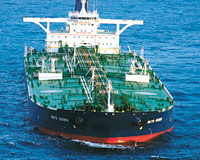
Operator Vela International, shipping arm of state oil giant Saudi Aramco, said the 25-man crew was believed safe. They are from Croatia, Britain, the Philippines, Poland and Saudi Arabia.
"At this time, Vela is awaiting further contact from the pirates in control of the vessel," Vela said.
Increasingly brazen pirate activity in the Gulf of Aden and Indian Ocean waters off Somalia has driven up insurance costs, forced some ships to go round South Africa instead of through the Suez Canal, and secured millions of dollars in ransoms.
The capture of the Star is one of the most spectacular strikes in maritime history. "It looks like a deliberate two fingers from some very bright Somalis. Anyone who describes them as a bunch of camel herders needs to think again," one Somalia analyst said.
The seizure was carried out despite an international naval response, including from the NATO alliance and European Union, to protect one of the world's busiest shipping areas. US, French and Russian warships are also off Somalia. Saudi Foreign Minister Prince Saud al-Faisal said his country would throw its weight behind a European-led initiative to step up security in shipping lanes off Africa's east coast.
"This outrageous act by the pirates, I think, will only reinforce the resolve of the countries of the Red Sea and internationally to fight piracy," he said.
But underlying the difficulty of containing the problem, China's official Xinhua agency said on Tuesday a Hong Kong cargo ship was hijacked by pirates in the Gulf of Aden. Andrew Mwangura, coordinator of the East African Seafarers' Association, said he thought a hijacked Nigerian tug was a "mother-ship" for the Nov. 15 seizure of the Saudi vessel. The fully-loaded supertanker was probably low in the water and therefore easy to board by ladder or rope, he said.
Normally, the increasingly well-armed and sophisticated Somali pirates use speedboats and satellite phones to coordinate attacks, with the mother-ship as a base for their operations. The seizure of the Star, three times the size of an aircraft carrier, followed another high-profile strike earlier this year by the pirates when they captured a Ukrainian ship carrying 33 tanks and other military equipment.
They are still holding that vessel and about a dozen others, with more than 200 crew members hostage. Given that the pirates are well-armed with grenades, machineguns and rocket-launchers, foreign forces in the area are steering clear of direct attacks. Ship owners are negotiating ransoms in most cases.
Middle East energy analyst Samuel Ciszuk said this would almost certainly be the case with the Sirius. "Due to Somalia's status as a failed state and the anarchic nature of politics in the country, the negotiators have no other option but to respond to the pirates. There is no government which can intervene."


