

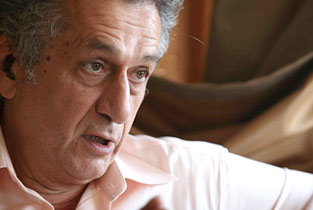
The European court unanimously held that there had been a violation of freedom of expression in the case of former prosecutor Sacit Kayasu, who was removed from his job because he filed a court case against Kenan Evren, the leader of Turkey's 1980 military coup. The decision is first expected to give Kayasu his old job back and, secondly, to open other HSYK decisions to judicial review.
According to professor of law Mustafa Şentop Thursday's decision was very significant. "Earlier, appeals against HSYK decisions were mostly about discipline procedures. This one was entirely a human rights issue. They have made the right decision. This should have major effects. First, a reversal of the HSYK decision. That is, returning Kayasu's right to practice law and, second, it should open HSYK decisions to judicial appeal in Turkey -- and not just the HSYK, but also other agencies, such as the Supreme Military Council [YAŞ], whose decisions cannot be appealed," Şentop said.
Noting that Turkey also has to pay Kayasu 40,000 euros in compensation, Şentop said the state should collect this money from the individuals responsible for the HSYK decision. "You have a prosecutor doing his job here. It is quite obvious that those who voted for his disbarment are at fault," Şentop said, arguing that the state should seek compensation from the people who were members of the HSYK at the time.
Şentop said the European court's ruling was not just significant because it is binding for Turkey, but also because it sets a precedent for domestic law. However, he added that he was not sure if a prideful agency like the HSYK would be willing to acknowledge and make up for its mistakes. "Kayasu will have to insist on getting his job back," he noted.
Kayasu, it seems, believes that not only he, but also other prosecutors who were barred from the legal profession by the HSYK for similar reasons -- such as Ferhat Sarıkaya, who also tried to indict a general -- will have the right to appeal their cases.
Sarıkaya, formerly a prosecutor in Van, was disbarred for having initiated an investigation into military commanders in regard to bomb attack on a bookstore in the Şemdinli district of Hakkari in 2005. The initial investigation into the bombing had revealed that the act was perpetrated by two noncommissioned gendarmerie officers and a Kurdistan Workers' Party (PKK) informant. After Sarıkaya, who was working on the case, deepened the probe and began a number of investigations into top army commanders, including former Chief of General Staff Gen. Yaşar Büyükanıt, he was disbarred by the HSYK.
" All prosecutors and judges complain about one issue the most: The HSYK can disbar a judge or prosecutor even if there is no conviction for the person in question. This is completely arbitrary," Kayasu says. Regarding the compensation that the Turkish government will have to pay him, he stresses: " This money is the taxpayers' money. The state should collect the money from those who ruled for my disbarment."
However, retired military judge Ümit Kardaş is not so optimistic. He stresses that in order for the decision of the European court to have a positive effect on domestic law, legislators should change the laws to integrate the logic of the ruling into the Turkish legal system. " It is not as though the HSYK is going to say, 'Oh look at the European court decision, let's give Kayasu his job back.' There absolutely must be political will to make the decision part of the law," he says. He cites the example of Turkey's conscientious objectors, who have been paid tens of thousands of euros in compensation as a result of the European court's decisions: " Do you see their situation here improving? No, it is like saying, 'I will pay for whatever wrong I do.' This is money paid from a budget created by all of us, as taxpayers."
" Turkey should correct its domestic laws first, and that won't happen by itself. There has to be political will for that to happen," Kardaş notes.
The European court's ruling
Kayasu served as a prosecutor until he was fired and disbarred in 2000 after asking the State Security Court (DGM) in Ankara to indict Evren for overthrowing a civilian government. In 2007 he completed his master's degree in law at Marmara University and is in the process of writing his thesis on " Freedom of Expression for Judges and Prosecutors."
In a statement regarding its decision, the European court observed the " possibility of prosecuting the instigators of the coup d'état of Sept. 12, 1980 and the Constitution, which had been adopted following a referendum in November 1982 and was still in force. This was unquestionably a debate of general interest, in which the applicant had intended to participate both as an ordinary citizen and as a public prosecutor."
The court also stated that the imposition of a criminal sanction of that nature on an official belonging to the national legal service would by its nature have a chilling effect, not only on the official concerned but on the profession as a whole.
In its verdict the court also questioned the status of the HSYK: " The Court observed that the impartiality of the bodies that had been called upon to review the applicant's objection had been open to serious doubt."


