

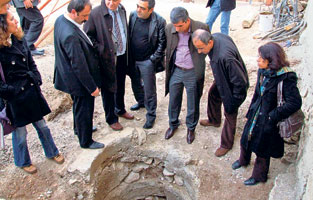
The skull fragment was found Saturday evening during an excavation led by Atilla Öztürk, the chief public prosecutor in the southeastern province of Şırnak. Nurşirevan Elçi, chairman of the Şırnak Bar Association, also observed the excavation.
Bone fragments, pieces of hair, remains of a sack and clothing were found during excavation last Wednesday. They were sent to a forensic lab for analysis to determine if the remains were human.
The existence of wells belonging to the state-owned Turkish Pipeline Corporation (BOTAŞ), also known as " death wells," has long been an issue of contention. Several people have claimed that JİTEM, a clandestine gendarmerie intelligence unit established in the late 1980s to counter ethnic separatism in the Southeast, was behind the killings of hundreds of people in the region in the 1990s. It was alleged that JİTEM summarily executed a large number of people, doused their bodies with acid and buried them in wells located near BOTAŞ facilities in several southeastern cities.
Hundreds of disappearances occurred in the region during the 1990s.
On Saturday, Democratic Society Party (DTP) leader Ahmet Türk claimed that someone tampered with excavation sites before investigators could arrive.
" If these wells had been dug up when the prosecutor's office issued its first ruling, I think we would have seen a different result," Türk said. He said it raised suspicions that the prosecutor's office waited a week to start the excavations after its initial announcement that the wells would be searched.
Türk said people in the region had made several allegations that " there were attempts to clean the wells."
Background on excavations
Though the existence of death wells was denied for many years, a prosecutor from the Silopi Public Prosecutor's Office conducted a field survey in February on BOTAŞ-owned land in Şırnak, calling for excavations at two sites in the area.
Many well-known figures have made statements about the existence of the death wells, also called " acid wells." Among these were Abdülkadir Aygan, a former JİTEM member, and Tuncay Güney, who is seen as a key figure in the ongoing investigation into a clandestine organization known as Ergenekon. Both previously claimed that the bodies of hundreds of people reported missing in the past might have been burned with acid and buried in wells in southeastern Turkey.
The death wells are believed to be linked to Ergenekon. Dozens of Ergenekon members are currently standing trial on charges of plotting to overthrow the government.
Southeast searches for its missing
The discoveries of bone fragments in death wells have renewed the hopes of the families of the missing persons in southeastern Turkey of finding out what happened to their loved ones.
According to the Şırnak Bar Association, the families of around 17,000 missing people have applied so far to the Silopi Prosecutor's Office to discover the whereabouts of the missing. The families are hopeful that the excavations at the BOTAŞ facilities will finally solve the mystery of the missing individuals. They also believe the ongoing Ergenekon investigation will shed light on the disappearance of their loved ones.


