

Israel launched a military offensive on Dec. 27 to force Hamas militants who control the Gaza Strip to stop firing rockets at southern Israeli towns. Some 1,300 Palestinians were killed, of whom over 700 were civilians according to a Gaza human rights group. Over 4,000 were wounded and thousands were made homeless after their houses were destroyed by bombing or bulldozers. Ten Israeli soldiers were killed in the fighting and three civilians were killed by Hamas rockets inside Israel before the two sides called a halt to the fighting on Jan. 18.
During the panel at the World Economic Forum (WEF) held in Davos on Thursday evening, Erdoğan -- who has so far not avoided reflecting his anger and feelings of offence due to the disproportionate use of force by Israel leading to the killings of hundreds of civilians -- encountered an audacious Peres, who launched a fiery defense of his country's offensive in Gaza over the past month, and with a raised voice and pointed finger, questioned what Erdoğan would do if rockets were fired at İstanbul every night.
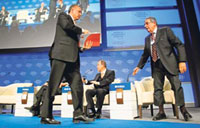
 Arab League Secretary-General Moussa congratulated Erdoğan as he walked off the stage at a WEF meeting in Davos on Thursday night. |
" When it comes to killing, you know very well how to kill," responded Erdoğan, visibly angry, as he sat next to Peres at the debate, which also included United Nations Secretary-General Ban Ki-moon and Arab League chief Amr Moussa.
Only a few hours before the debate, Erdoğan had said he " expected [new US President] Barack Obama be the voice of all those silent and destitute masses," while outlining his policies concerning the Middle East. One of the reasons why Erdoğan felt this much anger over Israel's deadly attacks was actually expressed again on Thursday afternoon.
Before the Dec. 27 attack on Gaza, Erdoğan said Turkey had been deeply involved in mediating between Israel and Syria, and was awaiting a response from Israeli Prime Minister Ehud Olmert when the bombs started falling in the Palestinian territory.
" I saw this as a lack of respect for us and also a shadow cast over peace," he said.
He appeared to express a sense of disappointment when he recounted how he had met with Olmert just days before the offensive, and believed they were close to reaching terms for a face-to-face meeting with Syrian leaders.
Turkey, a predominantly Muslim but secular country that historically has had good ties with Israel and the Arab world, also played a role in helping broker an end to the Gaza offensive, particularly by lobbying the Hamas group to declare a cease-fire.
 Crowds waited for PM Erdoğan upon his return from Davos with banners reading, " Let the world see a true prime minister" and " Conquerer of Davos." |
Delivering a public speech in İstanbul yesterday afternoon, Erdoğan stood firm behind his stance at the debate, saying he would not let anyone " show disrespect to the prime minister of the Turkish Republic."
President Abdullah Gül, a former foreign minister, lent support to Erdoğan's stance.
" Nobody should expect the prime minister of Turkey to accept a disrespectful act. He gave the necessary response," Gül told reporters yesterday.
Moderator
During the debate, as he spoke, Peres often turned toward Erdoğan, who in his remarks had criticized the 18-month Israeli blockade of Gaza, calling the narrow strip of land an " open air prison, isolated from the rest of the world," and referred to the Palestinian death toll of about 1,300.
" Why did they fire rockets? There was no siege against Gaza," Peres said, his voice rising in emotion. " Why did they fight us? What did they want? There was never a day of starvation in Gaza."
 David Ignatius |
Erdoğan's angry exit capped an hour-long debate at the forum attended by world leaders in Davos. Erdogan tried to rebut Peres as the discussion was ending, asking the moderator, Washington Post columnist David Ignatius, to let him speak again. " Only a minute," Ignatius replied.
" Mr. Peres, you are older than me. Your voice is too loud," Erdoğan told Peres, saying his emotion belied a guilty conscious. " You kill people," Erdoğan told the Israeli leader, speaking in Turkish through a translator. " I remember the children who died on beaches. I remember two former prime ministers who said they felt very happy when they were able to enter Palestine on tanks."
When the moderator tried to cut him off, saying time was up and that it was time for dinner, Erdoğan answered in frustration, " Don't interrupt me. You are not allowing me to speak."
He then said, " I will not come to Davos again."
Afterward, Erdoğan stressed he left not because of a dispute with Peres but because he was not given time to respond to the Israeli leader's remarks. Erdoğan also complained that Peres had 25 minutes while he was only given 12.
" I did not target at all in any way the Israeli people, President Peres, or the Jewish people," Erdoğan told a news conference afterward.
" I have known Shimon Peres for many years and I also know Erdoğan. I have never seen Shimon Peres so passionate as he was today. I think he felt Israel was being attacked by so many in the international community. He felt isolated," said former Norwegian Prime Minister Kjell Magne Bondevik, a Lutheran clergyman, on Thursday. " I was very sad that Erdoğan left. This was an expression of how difficult this situation is."
Real politics and sensitivities
Speaking in İstanbul yesterday, Erdoğan made clear that Turkey favors the maintenance of peace in the Middle East and nobody should misinterpret Turkey's " humanitarian sensitivities," in an apparent response to claims that Turkey's stance was encouraging for Hamas, which is accepted as a terrorist organization by the EU and the US.
" We don't believe that it is right to suppress our humanitarian characteristics in the name of realpolitik. It is extremely wrong to show the deaths of civilians as a simple accident of occupation. Remaining insensitive to cruelty is also cruelty," Erdoğan said, while reiterating that nobody could dare treating the prime minister of Turkey like " a clan leader."
Earlier in the day in Davos, Peres said he hoped relations with Turkey would not be affected by the heated exchange and added he had spoken to Erdoğan by telephone after the debate.
" We don't want conflict with Turkey. We are in a conflict with the Palestinians," Peres told reporters in Davos.
As of Friday afternoon, there was no official statement on the issue from Ramallah, the unofficial capital of the Palestinian National Authority. In Ankara, nonetheless, sources from the presidential palace said that Palestinian President Mahmoud Abbas will come to Ankara on Feb. 7.
Speaking at a press conference held at the Israeli Embassy in Ankara, Israel's Ambassador to Turkey Gaby Levy sounded confident about the future of bilateral relations between his country and Israel.
Israel and Turkey had overcome similar difficulties in the past, such as the one that occurred during Israel's 2006 offensive against Lebanon, Levy said, adding that with mutual calm, they would again overcome today's difficulties which are based on a differences of views.
'Israel doesn't listen'
Reaction around the world to the heated exchange in Davos has been mixed, with many commenting on the event. Some have expressed their admiration for Erdoğan " courageous" stance and walking out of the panel discussion, while others have conveyed their disappointment with the evening's events.
" Hamas pays tribute to the courageous stand of Turkey's prime minister ... who in Davos directly defended the victims of the criminal Zionist war against our children and women in Gaza," Fawzi Barhoum, a Hamas spokesman, said on Friday. " We consider his departure from the room as an expression of support for the victims of the holocaust carried out by the Zionists."
The American Jewish Committee (AJC), meanwhile, described Erdoğan's action as " a public disgrace that may well encourage further outrages against Israel and Jews."
" Prime Minister Erdoğan's tantrum at Davos throws gasoline on the fire of surging anti-Semitism," AJC Executive Director David Harris said in a statement.
For Amr Moussa, the secretary-general of the Arab League and former Egyptian foreign minister, also at the debate, Erdoğan's actions were understandable.
" Mr. Erdoğan said what he wanted to say and then he left. That's all. He was right," he said, adding that Israel " doesn't listen."
Gareth Evans, the president of the International Crisis Group think-tank, told Al Jazeera that Erdoğan's walk-out was " deeply depressing."
" I thought the tone of the debate had been reasonably moderate up until Shimon Peres laid some heavy-duty stuff on the line, in a very uncompromising and rather un-Peres like fashion," he said. " In particular, what was depressing was Peres' utter unwillingness to acknowledge the real significance of the Arab peace initiative and to respond to Erdoğan and Amr Moussa, saying how important it is that Israel formally say that the plan is a major step towards peace," Evans said. " Turkey was Israel's best friend in the Muslim world. I think Israel has to come to grips with the fact that it has alienated a very large proportion of the world's population."


