

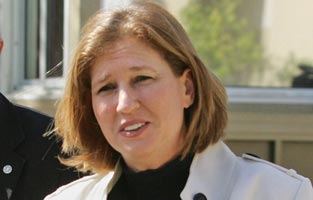
Livni's Kadima Party won 28 seats, just one more than Netanyahu's Likud, in Tuesday's election for the 120-member parliament, according to nearly complete results. With neither party winning a clear majority, neither can govern alone. Gains by right-wing parties give Netanyahu a better chance of forming a coalition with his natural allies.
The results set the stage for what could be weeks of coalition negotiations. Israeli media reported the first meetings were scheduled for Wednesday. Such paralysis could dampen prospects for Egyptian-led attempts to broker a truce between Israel and Gaza's Hamas rulers after Israel's devastating offensive in  Both centrist Foreign Minister Tzipi Livni (Above) and hard-line leader Benjamin Netanyahu claim victory in the election held on Tuesday. Livni's Kadima party won the most votes but had little chance of building enough support for a coalition. Netanyahu can get the support, but analysts say the likely coalition would prove dysfunctional. |
Anti-Arab kingmaker
It's up to Israeli President Shimon Peres to decide whether Livni or Netanyahu should have the first shot at forming a government. Peres will meet with party leaders to hear their recommendations, and then has a week to make up his mind. However, the final word may be up to ultranationalist Avigdor Lieberman, a former Netanyahu protege and perhaps Israel's most divisive politician, whose rightist Yisrael Beiteinu gained four seats in the election to hold 15. Lieberman kept his options open, saying he spoke both to Livni and Netanyahu after the polls closed. "We want a right-wing government," Lieberman told party activists, but added that "we do not rule out anyone." Several hours after polls closed, Livni and Netanyahu staged rival victory rallies.
Israeli electoral procedures Some 5.3 million people were eligible to vote, at 9,263 polling stations. Some 65.2 percent of them cast a ballot.Final results are certified as official when they are published on Feb. 18 in the gazette. The 120 seats in the single-chamber Knesset are allocated by proportional representation to party lists, which may secure seats after passing a minimum threshold of winning at least 2 percent of the national vote. Israel's president, currently Shimon Peres, holds consultations with parties, usually within several days of the election, and picks a legislator to try to form a government. Traditionally, the task goes to the leader of the party that won the most votes. The prime minister-designate has 42 days to form a cabinet and win parliamentary approval. If he or she fails, the president can ask another legislator to try to put together a team. Israel has always been ruled by coalition governments, since no one party has ever won enough votes in an election to secure a parliamentary majority of its own. Prime Minister Ehud Olmert, already serving in a caretaker capacity since resigning in September in a corruption scandal, remains in office until a new government is sworn in. Reuters Palestinians: Next Israeli government cannot bring peace Israel's next government, whether it is led by centrist Tzipi Livni or rightist Benjamin Netanyahu, will be unable to forge peace with the Palestinians, a top Palestinian negotiator said. "Regardless of the coalition formed by any Israeli prime minister, the next Israeli government will be unable to deliver the requirements of peace," Saeb Erekat said after election exit polls showed Livni's Kadima party with a narrow 2-seat lead over Netanyahu's Likud party, but parliament leaning rightward. "If the new Israeli government continues to expand settlements, place roadblocks and obstruct a two-state solution, we have no option but to consider it a non-partner in peace," Erekat said. Ramallah Reuters |
"With God's help, I will lead the next government," Netanyahu told cheering Likud activists early Wednesday. An hour later, Livni told her supporters that "the people have spoken, and they have chosen Kadima." Nearly everyone seemed to agree on one thing after Israel's fifth election in a decade - that the nation's election system isn't working. Livni, Lieberman, and Defense Minister Ehud Barak of the Labor Party said in post-election speeches that the system, in which votes are splintered among a proliferation of parties, must be changed to allow more stability. With all of the civilian votes counted, Kadima won 28 seats, Likud 27 and Yisrael Beiteinu 15. Labor, for decades Israel's ruling party, won just 13 seats. Overall, right-wing and religious parties won a total of 65 seats, compared to 55 for center-left and Arab parties.
The tally did not include thousands of votes by soldiers, to be counted by Thursday evening. They could shift the final results by a seat or two. Lieberman says he wants to redraw Israel's borders in order to push out heavily Arab areas and require those who remain to sign a loyalty oath or lose the right to vote or run for office. Some 20 percent of Israel's 7 million citizens are Arabs, and about a dozen serve in parliament. Lieberman's party draws strong support from immigrants from the former Soviet Union, many of whom are secular and feel stifled by Israel's ultra-Orthodox religious establishment. Netanyahu has strong ties to Jewish religious parties, particularly the ultra-Orthodox Shas, whose spiritual leader has said a vote for Lieberman is a vote for Satan.
During Netanyahu's three-year term as prime minister a decade ago, he largely froze the interim peace deals his predecessors negotiated with the Palestinians. Netanyahu has derided the past year of peace talks under Kadima as a waste of time, and said he wants to focus on reviving the Palestinian economy. He has also called to crush Hamas, the Islamic militant movement that seized the Gaza Strip by force in June 2007, and remove it from power.
Livni has said she would continue peace talks with moderate Palestinian President Mahmoud Abbas. But she also advocates a tough line against Hamas and was one of the architects of Israel's three-week Gaza war, which ended with a temporary cease-fire on Jan. 18. Abbas will restart talks only if Israel commits to a settlement freeze, his aides said Tuesday, posing such a condition for the first time. "We now have clear conditions for whoever heads the Israeli government," said Rafiq Husseini, an Abbas adviser. "The conditions begin with the halt of settlement activities immediately." Netanyahu wants to expand settlements, and even under the outgoing Kadima-led government, in which Livni served as chief negotiator, construction accelerated.
 Avigdor Lieberman's far-right, anti-Arab Yisrael Beiteinu party, now third largest, emerged as a potential kingmaker. Lieberman and religious parties in a Netanyahu coalition would oppose any peace moves with the Palestinians. |
The Palestinians want all of the West Bank for a future state, along with Gaza and east Jerusalem. They say the West Bank settlements, home to nearly 300,000 Jews, will make that impossible. It was not immediately clear whether the prospect of weeks of political paralysis would lessen chances for a long-term Gaza truce and a prisoner swap between Israel and Hamas. Under the proposed exchange, Israel would free hundreds of Palestinians for an Israeli soldier held since June 2006 by Hamas-allied militants. Prime Minister Ehud Olmert, freed from concerns about political fallout, could approve a deal before the new government is sworn in. A swap is linked to efforts to reach a permanent truce on the Gaza-Israel border. Hamas wants Israel and Egypt to lift their blockade of Gaza, while Israel wants a halt to arms smuggling into Gaza.


