

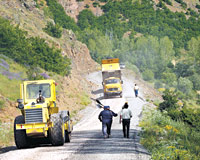
The Back to the Village Project aims to help families who left their villages return, making sure that they can reside in their old village or in another location nearby and have access to necessary social and economic infrastructure in the area. The project focuses on the 14 cities (Adıyaman, Ağrı, Batman, Bingöl, Bitlis, Diyarbakır, Elazığ, Hakkâri, Mardin, Muş, Siirt, Şırnak, Tunceli and Van) out of which terrorism-related migration has been highest. Under the project, the state gives funds to agricultural, farming and handcraft projects to start life once again in abandoned villages and make it permanent. So far, 151,469 people have returned to their villages. In 2009, the ministry is to focus on the project as a priority area, ministry officials say.
Recent steps taken by the government to support investment in the region have made returning to the Southeast easier for people who left their hometowns because of terrorism. In addition to the Back to the Village project, a massive housing project and more factories and businesses providing employment provide further stimulus. In the past four or five years, the number of factories in Diyarbakır alone rose from 60 to 95. Van, which only had five factories a few years ago, boasts 48 today. Also, cities in the region now have fully equipped hospitals; locals previously had to travel long distances for treatment. The largest private hospital in the region was set up in the region during this time in Şanlıurfa.
İsmail Demirkol, head of the Şanlıurfa Chamber of Trade and Industry, says investment over the past five years greatly changed the region's façade. " We have seen many governments over the years and have hosted numerous prime ministers. Ministers came and left, new packages were announced, but not one of the projects was realized. If you ask us, the current government has done far more serious work compared to previous governments," he said.
Mardin Governor Mehmet Kılıçlar said eight new hotels, four being boutique hotels, have been opened in Mardin. " We don't have a single village left without water now," Kılıçlar said.
Zeynep Akbel, who heads the Batman Organized Industrial Zone, said 20 new facilities will begin operating soon, stating that 15 companies are currently active in the zone. She said close to 1,500 people would find new jobs once the 20 worksites are completed.
The Ministry of Agriculture has also invested in the impoverished East and Southeast of the country. It spent YTL 48 million on eight projects, specifically concentrating on decreasing rural unemployment rates. The Education Ministry also intensified efforts to improve enrollment rates, particularly for girls, in the area. Hundreds of schools were built over the past three years. Batman now has 485 schools, up from 392 before the latest investments. The number of schools in Mardin rose from 663 to 723.
Businessmen who have been increasingly realizing the region's potential for tourism have been investing. In Mardin, a city that hosts 700,000 domestic and foreign tourists every year, the number of hotels has significantly increased. The Mardin Cement Factory is now listed as among the best 100 companies in Europe.
Rural Development Investments projects, supported by state subsidies, provided many opportunities for investment in the region. In Şanlıurfa, greenhouses established thanks to regional incentives, started exporting products to countries such as Russia and Ukraine. Osman Baysal, who invested YTL 350,000 for a factory in the region, says he was granted a state subsidy of YTL 170,000.
" Whoever invests in the region, we'll pay half of it," says Ferhat Şelli, deputy undersecretary of the Ministry of Agriculture, adding: " A thousand families in Şanlıurfa found jobs in 88 projects. This is roughly enough jobs for 6,000 people."


