

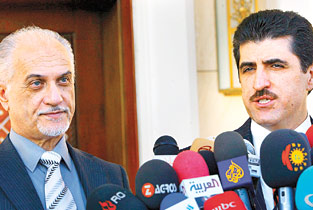
The pact, agreed after nearly a year of grueling negotiations with Washington, must still be approved by the Iraqi parliament, but Foreign Minister Hoshiyar Zebari said he expected that to happen by the end of the month.
It gives a closing date to pull out troops from a war that has been one of the defining political issues in the United States, the Middle East and around the globe for much of the past decade.
"The total withdrawal will be completed by Dec. 31, 2011. This is not governed by circumstances on the ground. This date is specific and final," cabinet spokesman Ali al-Dabbagh said.
He said the pact was supported by 27 of 28 cabinet members who attended a meeting to vote on it. Nine were not present.
Dabbagh said most major factions in parliament had indicated their support. Deputy parliament speaker Khaled al-Attiya said a first reading would be held in the chamber today.
The draft would place the US force in Iraq -- which now numbers about 150,000 -- under the authority of the Iraqi government for the first time, replacing a mandate enacted by the UN Security Council after the US invasion.
It calls for US forces to leave the streets of Iraq's towns and villages by the middle of next year. Dabbagh said US forces would hand over their bases to Iraq during the course of 2009 and would lose the authority to raid Iraqi homes without an order from an Iraqi judge and permission of the government. A US Embassy spokeswoman called the cabinet's endorsement "an important and positive step." With the government's backing, passage in parliament seems likely although not assured. Followers of anti-American Shiite cleric Muqtada al-Sadr oppose the pact, and the largest Sunni Arab bloc says it wants it put to a referendum.
Confidence
The Iraqi government has grown increasingly confident of its own ability to keep order as violence has dramatically reduced in the country over the past year. Iraqi forces now have command in all but five of Iraq's 18 provinces, and took the lead in a crackdown on Shiite militias earlier this year. October saw the lowest monthly death toll from violence since the invasion, according to Iraqi government statistics.
But Iraqi officials acknowledge they still need US military support against Sunni militants in Baghdad and four northern provinces, as well as aid in logistics and fire power. Iraqi leaders consider the firm deadline for withdrawal to be a negotiating victory. The outgoing US administration of President George W. Bush long opposed setting any timetable for its troops to withdraw, but relented in recent months. The latest draft, submitted by Washington after the Iraqi cabinet balked at an earlier version last month, even changes the agreement's title to refer explicitly to the withdrawal.
Sadr's followers remain implacable foes of the pact, despite the withdrawal deadline which was their main demand. "Today the cabinet has agreed to put Iraq under the mandate of the American occupation forces. It is a deeply regrettable and sorrowful thing," Ahmed al-Masoudy, spokesman for Sadr's bloc in parliament, said. "We are calling upon the Iraqi people to stage demonstrations and sit-ins to stop this farce." The Accordance Front, the largest Sunni Arab bloc, wants a referendum on the pact, and spokesman Salim al-Jubouri said the group would therefore try to block it in parliament. Some Iraqi politicians have said it is easier to endorse the pact since the election this month of Barack Obama -- who favors withdrawal -- to replace Bush. Obama's own plan calls for all combat troops to be withdrawn by the middle of 2010. Baghdad Reuters
Suicide bomb kills 15, wounds 20 in N. Iraq
A suicide car bomber killed 15 people, including seven policemen, and wounded 20 in Iraq's volatile northern Diyala province on Sunday, police said. Police said the bomber targeted a police checkpoint in the province north of Baghdad, where al-Qaeda militants still operate despite being driven out of other parts of Iraq. Baghdad, Reuters


