

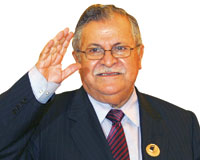
But Talabani, who was born in 1933 and underwent heart surgery in the United States in August last year, will remain head of the Patriotic Union of Kurdistan Party, said Fouad Masoum, a senior parliamentarian from the Kurdish alliance.
"It doesn't mean he will give up his political life. It just means he will not go for the presidential post," he told Reuters on Saturday. "He wants to take a rest."
Talabani, a Kurd, has been president since 2005. Although he does not wield executive power in Iraq, his role is seen as critical in maintaining the country's delicate ethnic balance. His two vice presidents are a Shiite and a Sunni Arab.
Their mandates expire at the end of December, when Iraq holds parliamentary polls that could radically alter the power balance in Prime Minister Nouri al-Maliki's coalition government. Parliament elects the three-member Presidency Council.
Masoum said Talabani's role as broker between Iraq's often fractious ethnic and sectarian groups had worn him out.
Talabani, a Kurd, has been president since 2005. Although he does not wield executive power in Iraq, his role is seen as critical in maintaining the country's delicate ethnic balance. His two vice presidents are a Shiite and a Sunni Arab. |
"That task is very tough ... working with all Iraqi parties and trying to bring together their diverse viewpoints," Masoum said, adding Talabani's decision was not final. An end to the official role for the country's most powerful Kurd comes at a delicate time for Iraq as rival parties vie for power and the United States prepares to pull out combat troops six years after the US-led invasion to oust Saddam Hussein.
Relations between the Shiite Arab-led government in Baghdad and largely autonomous Kurdistan in the north have deteriorated over the last year and are likely to remained heated. Disputes over territory along the Kurdistan border and rights to vast oil reserves in disputed areas show no sign of being resolved.
It is not clear who might replace Talabani.
"It's too early to say ... but I believe the next president will not be an Islamist or a Kurd," said Usama al-Nujaifi, an Sunni Arab politician member of former Prime Minister Ayad Allawi's secular party. "The Iraqi people want an Arab president ... not someone who came into power through the occupation."
One of Talabani's natural allies in the Kurdish alliance said they would not have a problem with that in principle.
"We know the Iraqi constitution does not say the president must be Kurd or Arab, Sunni, Shiite, Christian. We are not expecting the office to be occupied by a Kurd. For all we know, we (Kurds) might produce the next prime minister," said Kurdish alliance lawmaker Feriyad Rawanduzi. Though Talabani has usually sought to stay out of Iraq's political wrangling, his council's veto has sometimes shot down legislation that would have been divisive.
In July last year, he blocked a provincial elections law that his fellow Kurds bitterly opposed because they feared it would set back their goal of controlling the oil-rich city of Kirkuk. The law was later redrafted to please all sides.


