

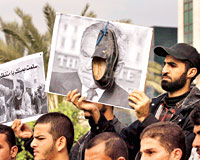
In Friday's protest, the Bush effigy was placed on the same pedestal, and after a mass prayer, demonstrators pelted it with plastic water bottles and sandals. One man hit it in the face with his sandal. The effigy fell head first into the crowd and protesters jumped on it before setting it ablaze.
The area was closed to vehicle traffic and heavily guarded by Iraqi soldiers in Humvees. Army snipers took positions on top of buildings overlooking the square. The Sadrists also provided their own security, searching worshippers as they approached the square.
Iraq's parliament is expected to vote next week on the plan, but the vocal opposition by the Sadrists and other groups in the 275-seat legislature indicate that even if it is approved, the deal could remain divisive in a country struggling for reconciliation. "This crowd shows that opposition to the agreement is not insignificant and parliament will be making a big mistake if it chooses to ignore it," said Salah al-Obeidi, an al-Sadr spokesman.
Opponents view the security deal as a surrender to US interests despite Prime Minister Nouri al-Maliki, a Shiite, saying the pact would eventually lead to full sovereignty. "Let the government know that America is and will not be of any use to us because it is the enemy of Islam," al-Sadr said in a sermon read by his representative, Sheik Abdul-Hadi al-Mohammadawi. "The government must know that it is the people who help it in the good and the bad times. If it throws the occupier out, all the Iraqi people will stand by it," he said, using common rhetoric for the United States. He also reiterated that his followers in both the armed and the peaceful factions of his movement will continue to work for the removal of US forces.
The sermon was punctuated by chants of "Yes, yes to Muqtada!" and "No, no to America!" The protest, which included two Sunni clerics, was held at Firdous Square, where US Marines tore down a statue of Saddam in one of the iconic images of the US-led invasion in 2003.
Many protesters arrived at the square on foot or by bus and carried prayer rugs, pieces of cardboard or newspapers to squat on during the prayer. They waved Iraqi flags and green Shiite banners, chanting, "No, no to the American agreement!" and, "No, no to the agreement of humiliation!"
Al-Maliki's Cabinet has approved the pact, meaning it has a good chance of passage in parliament where the government's parties dominate. But for al-Maliki's Dawa party and the Supreme Islamic Iraqi Council, its main coalition partner, the margin of support is almost as important as the victory itself. A narrow vote for approval would cast doubt on the legitimacy of the new terms governing the US troop presence and could influence their fortunes in provincial elections on Jan. 31 and a general election late in 2009.
Al-Sadr's followers and other legislators opposed to the pact are likely to use a narrow vote to try to turn their anti-American message to their advantage in the polls. If the agreement passes the legislature, it will go to the president and his two deputies for ratification. Each one of the three has veto power.
Those firmly opposing the agreement include the 30-seat Sadrist bloc, the Shiite Fadhila party with 15 seats in parliament and a small Sunni Arab bloc that has 11 seats. The Shiite government bloc has 85 seats in addition to more than 50 held by Kurdish parties that support the pact, constituting a small majority.


