

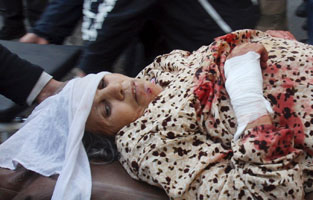
Israel's push into the Tel Hawwa neighborhood was the furthest it has moved into Gaza City during an 18-day offensive against Hamas, bringing Israel's ground forces within one mile (1.5 kilometers) of the crowded city center. Palestinian hospital officials say well more than 900 Palestinians, half of them civilians, have been killed. Israel launched the offensive on Dec. 27 to end years of Palestinian rocket attacks on its southern towns, and Prime Minister Ehud Olmert has vowed to press forward with an " iron fist," despite growing international calls for an end to the fighting. UN chief Ban Ki-moon headed to the region on Tuesday to press for a cease-fire.
Palestinian witnesses said the Israeli forces moved overnight about 300 meters into Tel Hawwa, a neighborhood of high-rise buildings on the southeastern edge of Gaza City. Palestinian medical officials reported at least 16 people killed in fighting, though the Israeli army suggested the number could be much higher.
One resident, Khader Mussa, said he fled his house while waving a white flag as the Israeli forces advanced. He spent the night huddling in the basement of a relative with 25 other people, including his pregnant wife and his parents.
"Thank God we survived this time and got out alive from here. But we don't know how long we'll be safe in my brother's home," Mussa, 35, told the AP by telephone. Several buildings were on fire, witnesses said, including a lumberyard. Sounds of the battle could be heard clearly around the city of 400,000 as the Israeli forces, backed by artillery and attack helicopters, moved into neighborhoods east and south of Gaza City. Israeli gunboats shelled the coast from the west.
The Israeli military said it carried out some 60 air strikes overnight, hitting groups of Hamas militants holed up in a hotel, a house and a mosque. It said it also struck 15 squads of gunmen, rocket launching sites and 15 smuggling tunnels along the Egyptian border.
The army said it had killed or wounded about 30 Palestinians, and that three soldiers were wounded in overnight fighting. Among them was an officer who was seriously wounded when a bomb exploded in a northern Gaza house that he was searching. Dr. Moaiya Hassanain, a Palestinian Health Ministry official said dozens of calls for ambulances had been received, but they could not be dispatched because of the fighting.
|

The Gaza fighting has raised tensions around the region and galvanized anger toward Israel throughout the Arab world. On Tuesday, one or more gunmen opened fire at an Israeli army patrol along the desert border between Israel and Jordan, the military said. There were no casualties, and Jordan said the claim was "baseless."
There was a similar shooting incident on the Israel-Syria border on Sunday, and last week militants in Lebanon fired rockets into an Israeli town in an apparent attempt to draw Israel into a second front.
The Israeli military has tightly controlled information from the battlefield, but indications have been that Hamas has not put up a serious fight. Of the nine Israeli soldiers killed during the offensive, four were killed in "friendly fire incidents." And repeated Hamas claims of spectacular attacks on the Israelis have turned out to be false.
Speaking in parliament on Tuesday, Israel's military chief said his troops have inflicted heavy damage on Hamas, but would continue fighting to achieve more.
Palestinian rocket fire has been greatly reduced, but not halted altogether, since the offensive was launched. As diplomats struggled with the truce efforts, Israeli Prime Minister Ehud Olmert said Israel would end the military operations only when Hamas stops rocketing Israel and halts weapons smuggling across the porous border.
"Anything else will be met with the Israeli people's iron fist," Olmert said, "We will continue to strike with full strength, with full force until there is quiet and rearmament stops."
He spoke on Monday in the town of Ashkelon, where life has largely been paralyzed by rocket fire from Gaza. Later, he tempered his tough talk, saying: "I really hope that the efforts we are making with the Egyptians these days will ripen to a result that will enable us to end the fighting." Egypt, which often mediates between Israel and Hamas, and international diplomats have been furiously working toward a solution that would stop the fighting.
In a speech broadcast on the group's Al Aqsa TV station, Hamas Prime Minister Ismail Haniyeh claimed his group would continue fighting, but said it was pursuing diplomacy to end the conflict. He said any truce would require an Israeli withdrawal from Gaza and the opening of the territory's blockaded borders.
"As we are in the middle of this crisis, we tell our people we, God willing, are closer to victory. All the blood that is being shed will not go to waste," Haniyeh said. Like other Hamas leaders, Haniyeh is in hiding, and it was not clear where he was speaking.
Inside Gaza on Monday, an Israeli battalion commander identified only as Lt. Col. Yehuda said troops had not met significant resistance. He said troops found several houses booby-trapped either with regular explosives, or by sealing the windows and doors and opening cooking gas valves.
"A couple of days ago, an armed squad popped up from a tunnel that was concealed by a nearby building. We took them out with tank fire and a bulldozer," he said.The officer's comment was approved by Israeli military censors. He spoke to a small group of reporters who accompanied Israeli units inside Gaza. Israeli forces have not allowed journalists to enter Gaza to cover the war.


