

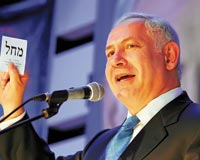
His main opponent, the centrist Kadima Party leader Tzipi Livni, said she would continue the US-sponsored peace process with the Palestinians that she pursued as foreign minister -- an outcome favoured by the new Obama administration in Washington. Netanyahu, a hawkish former prime minister, has seen his Likud Party's lead in polls crimped by a surge in support for a former aide, Avigdor Lieberman, whose anti-Arab rhetoric has attracted voters from beyond his party's Russian-speaking base in the wake of last month's war in the Hamas-ruled Gaza Strip.
Focusing his fire on Livni, Netanyahu told Israel Radio: "She's already given up Jerusalem in negotiations with the Palestinians ... Why? Haven't they learned a lesson from all their failures over the past three years -- the thousands of missiles that hit us from Lebanon and Gaza? Whoever wants to continue down this path, should vote Kadima." Netanyahu, as when premier in 1996-99, doubts Palestinians can establish a state that does not pose a threat to Israel and has said his priority for stemming violence in the West Bank would be to promote economic growth in special industrial zones. He opposed pulling troops from Gaza in 2005, the event that split Likud and created Kadima. He says Hamas rocket fire that has peppered southern Israel since then, like Hezbullah rockets that have hit the north since troops quit Lebanon in 2000, are the fruit of trading land for peace. He also rejects US calls for a freeze in expansion of West Bank Jewish settlements.
Underlining his reluctance to follow outgoing Kadima Prime Minister Ehud Olmert in similar talks with Syria, Netanyahu on Sunday visited the Golan Heights, the strategic plateau Israel annexed after a 1967 war and vowed not to accede to Damascus's demands for the territory as its price for a peace treaty: "Whoever wants the Golan to remain in our hands, all of Jerusalem to remain in our hands, and that we have defensible borders, should vote Likud," he said in televised remarks. Livni took over Kadima when Olmert was forced to step down in a corruption scandal but she failed to rally support for a new coalition in the autumn, triggering this week's election.
Livni loyal to Annapolis
Livni and Defense Minister Ehud Barak's Labor Party have not benefited much in polls from the solid support enjoyed by the government's offensive in Gaza, which killed 1,300 Palestinians.
But the dent in Netanyahu's numbers, apparently caused by Lieberman's Yisrael Beiteinu (Our Home is Israel), has revived her hopes of becoming Israel's first woman leader since the redoubtable Golda Meir of the Labor Party in the 1970s. Responding to a rightward shift in the electorate, she said on Sunday she would press on with the talks she held with Palestinian leaders in the occupied West Bank, a process begun at Annapolis in 2007 sponsored by US President George W. Bush.
"I will continue down the path I laid out with my partners on the Palestinian side," she told Army Radio. "I'm not prepared to be a prime minister whose hands are tied in a government without any peace process. That is an intolerable price." Such determination could limit her coalition options. Polls show no party winning more than a quarter of the 120 seats. By tradition, President Shimon Peres will first ask the leader of the biggest bloc in parliament to form a government, though some analysts question whether Livni would manage that, even if Kadima overturns Likud's 2-3 seat lead in opinion polls.
Lieberman quit Olmert's coalition a year ago in protest at the Annapolis negotiations and talk that Kadima was ready to cede a share of Jerusalem and Jewish settlements in the West Bank in return for a peace deal with a new Palestinian state.REUTERS JERUSALEM


