

Mehmet Seyfettin Erol, a professor of international relations at Gazi University in Ankara, said the two capitals have been waging a psychological war for some time now. Stressing that the Israeli media has always adopted a state ideology in foreign relations, Erol said media organizations are being used as a proxy by the government of Israel in extending tension. The reporting went so far as to fabricate a story that a synagogue in northwestern Turkey was set ablaze on Sunday.
Based on interviews with Jewish community leaders in Bursa, Turkey's Cihan news agency refuted a story that appeared in Haaretz, an English language daily in Israel. A statement by the Office of the Chief Rabbi, Rav Izak Haleva, said no such incident took place in the city and no synagogue had been torched by vandals as was claimed by an article in Haaretz written by Yoav Stern.
The Haaretz article is just one example of many that appeared in the Israeli press recently, many observers in Turkey argue. Another appeared in the right wing conservative daily The Jerusalem Post claimed that the number of Turkish Jews migrating to Israel will double this year. The story said only 250 Turkish Jews -- compared to 125 last year -- are expected to migrate to Israel this year out of a 25,000-strong Turkish Jewish community. The article noted that many of the Turkish Jews seeking to migrate were students or young couples wanting to study at Israeli universities or to live in Israel.
The Jerusalem Post published another article suggesting that Israel may reject Turkish requests for arms. Based on an anonymous official defense source, the paper said Turkish requests recently submitted to the Defense Ministry's Foreign Defense Assistance and Defense Export Organization (SIBAT) will need to be reviewed due to the change in political ties between Jerusalem and Ankara. Erol argued that Israel stands to lose in this tension as Ankara has already diversified its defense procurement sources for quite some time now. " Russia, China and other countries may very well be the ones who are sting on the table of defense tenders" he said.
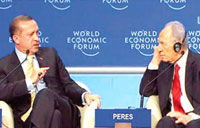
 Turkish Prime Minister Recep Tayyip Erdoğan's public confrontation with Israeli President Shimon Peres in Davos drew criticism from the Israeli media. |
Turkey seems to have more leverage against Israel should it come to military and defense contracts, one analyst said in Turkey. For example, Turkey may cancel an arrangement allowing the Israeli Air Force to train and fly in Turkish airspace. However, no concrete actions have been taken against Tel Aviv so far. The Post itself quoted a senior official saying that " despite all the talk, no joint economic initiatives between the two states have been canceled," In particular, plans for a joint Israeli-Turkish infrastructure and energy corridor between the ports of Ceyhan and Haifa are still under way, the paper added.
According to The Post, two Israeli companies most likely to suffer from a collapse in ties are the Israel Aerospace Industries (IAI) and Rafael Advanced Defense Systems Ltd. In December, subsidiaries of IAI and Elbit Systems signed a $140 million deal to supply the Turkish Air Force with targeting pods. Israeli Military Industries (IMI) recently completed a $700 million deal signed several years ago with Turkey to upgrade the country's fleet of aging Patton-series M60 tanks. IAI also recently supplied Turkey with its advanced long-range Heron unmanned aerial vehicle.
However, Israel has been late in fulfilling terms of contracts in both tank modernization and Heron deliveries. There has been discussion for some time now that Ankara needs to revisit these contracts and may even need to cancel and procure somewhere else. The article also noted that Turkey can lose lucrative trade deals with Israel, which amount to almost $4 billion annually, 60 percent of it in Turkish exports to Israel. However, this is a double-edged sword as it also means losing close to $2 billion in trade revenue for Israel.
The Post said Turkey may lose tourism revenue from Israel. It is a well-know fact that Israelis curtail overseas trips at time of war especially to Muslim countries where mass rallies against Israeli offensives are stronger. Pundits point out that Israel is not only losing the publicity campaign with its latest military strike on Gaza and paying a hefty price but that it is also jeopardizing the safety and security of Jews all over the world by providing an excuse to radical militants who are ready to capitalize on human misery. They stress that the Israeli public should blame its own leaders and hold them accountable for this mistake by leveling criticism against policy makers who took them on this thorny road.
Some Israeli commentators have tried to put the spotlight on Turkey and suggest that it is taking sides with Hamas. Erol says this is a cheap argument that does not hold any water. Both Prime Minister Recep Tayyip Erdoğan and Foreign Minister Ali Babacan have repeatedly condemned terrorist attacks carried out by Hamas militants against Israeli civilians. " To expect anything else from Turkish leaders when it comes to civilians on the other side of the aisle -- i.e., Palestinians -- is simply wrong and shows a lack of a backbone in the universal principle of sanctity of human life," Erol stressed.
Though the world saw some criticism of Israeli actions by groups in Israel and overseas, Jewish communities, including those in Turkey, need to be more outspoken on a human tragedy that has claimed more than 1,300 Palestinian lives and left around 5,400 wounded. Voicing concern over rising anti-Semitic sentiments worldwide was quite understandable and seen as a legitimate argument. Erdoğan noted that anti-Semitism is a crime against humanity while addressing supporters last week.
On Jan. 21, five Jewish-American organizations, the American Jewish Committee, the Anti-Defamation League (ADL), B'nai B'rith International, the Conference of Presidents of Major American Jewish Organizations and the Jewish Institute for National Security Affairs (JINSA), sent a letter to Erdoğan expressing their " profound concern over the current wave of anti-Semitic manifestations in Turkey." The letter would have carried more weight to ordinary Turks if there had been a similar letter drafted by the same group and addressed to the Israeli prime minister expressing their dismay on the civilian causalities incurred by the Palestinian people, some commentators said in Turkish media.
Turkey and Israel have enjoyed friendly relations for a long time and it has not seen any concrete measures taken against Israel yet. Erdoğan has so far refused to yield in implementing sanctions such as canceling defense contracts or recalling the ambassador from Israel. In doing so, he was slammed by opposition parties for not doing enough in Parliament discussions and his criticism of Israel is described as mere hot air. Realizing that it might change, Israeli leaders have scrambled to soften the tone and repair the damage done by the Gaza onslaught. Prime Minister Ehud Olmert ordered his ministers to not speak harshly of Turkey and most comments appearing in Israeli media relied on unnamed government officials.
Many analysts are now asking the same question: Does Turkey really need Israel on its side? " Well not as much as Israel needs Turkey in a hostile region where some have even refused to acknowledge Israel's existence and sworn to eradicate Jews from the face of the earth," Erol said. Turkey was the first Muslim nation to recognize Israel as a legitimate government and long maintained cozy, yet at times bumpy, relations with Israel. It recognized Israel in 1949. But staging an offensive against Gaza at a time when Turkey is trying to broker a peace deal between Israel and Syria was simply not acceptable to Turkish foreign policy makers who were busy in trying to hammer out remaining differences just four days before Gaza attack.


