

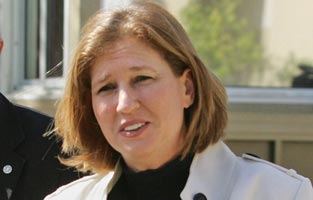
Such a power-share could help resolve an Israeli political stalemate after Tuesday's parliamentary election, but still slow the efforts of U.S. President Barack Obama to revive Israeli and Palestinian peace talks for a two-state solution. Election results published on Thursday after a count of soldiers' and prisoners' ballots showed no change in the initial results, with Livni's Kadima Party winning 28 seats, and 27 for former premier Netanyahu's Likud.
The remaining seats were distributed among 10 smaller parties including the left-wing Labor, headed by Defense Minister Ehud Barak. Once Israel's dominant party, Labor registered its worst result in history, winning just 13 seats.
With such a close outcome, both leaders were vying for President Shimon Peres to nominate them as prime minister, which he will do only after consulting with political party leaders next week. He has a week to designate someone from the moment final results are published in the official gazette on Feb. 18.
On election night, Livni called on Netanyahu to join her in a national unity government led by herself, something she offered last year before opting instead to call for an early election. Netanyahu has said he wants to be prime minister.
A leading newspaper, the mass-circulation Maariv, said behind-the-scenes talks were under way on a grand coalition of Kadima and Likud, with Labor. Together these parties would command 68 seats in Israel's 120-member parliament, wrote Maariv's senior political correspondent Ben Caspit.
One possible outcome might be these three secular, mainstream parties agreeing to form an administration that would reform voting rules to curb small religious and fringe groups. Livni's camp had no immediate comment. Yisrael Katz of Netanyahu's Likud denied the report, but told Israel Radio Likud was interested in Kadima joining a coalition led by Netanyahu. REUTERS JERUSALEM


