

Most analysts agree that key detentions made on Wednesday in the investigation of Ergenekon, a clandestine network of groups and individuals accused of trying to overthrow the government, are a milestone in the country's history, but some opponents of the investigation, including the Republican People's Party (CHP), have strongly responded to the arrests in what appears to be an attempt to influence the judicial process and public opinion.
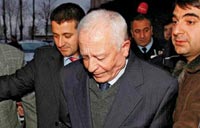
Retired generals and other army members on active duty were detained Wednesday along with at least 30 others as part of the ongoing Ergenekon investigation. A former senior prosecutor and the former head of the Higher Education Board (YÖK) were among those detained. The retired generals were all serving in the late '90s and have been known for playing key roles in the process of Feb. 28, 1997, which started when a government was forced to resign with an unarmed military intervention on that day.
After the detentions, CHP leader Deniz Baykal immediately called a news conference, claiming that the detentions were politically motivated and that they were an attempt on the part of the government to "change the regime." On Wednesday evening, the General Staff also called an immediate meeting of force generals, who did not issue a statement after their six-hour-long meeting following the operation.
Early Thursday morning, İstanbul Bar Association President Muammer Aydın accused the prosecution of not following the correct procedures in making the detentions. He said the Ergenekon investigation, "which started out as an investigation against a supposed criminal formation," was going on endlessly with new detentions and arrests with no consequences. Another meeting was held by the Council of Chairmen of the Supreme Court of Appeals, which also made no statement.
Many believe such a reaction against the detentions is dangerous and might harm the investigation. " Although there is a political will to do that, there is obviously uneasiness from the side of the judiciary, the military bureaucracy and other groups, which might stall the Ergenekon investigation eventually," warned Yusuf Alataş, former head of the Human Rights Association (İHD). " Political will alone might not be enough. Baykal defending the suspects might make solving this network of shady relationships very difficult," he noted.
But the apparent fight is a necessary evil, said Ümit Kardaş, a retired military prosecutor. " Ergenekon naturally caused divisions. The prosecutor is making these detentions based on some evidence," he said, adding that some groups' attempts to denounce the investigation were clearly aimed at influencing the judiciary. " And not only the judiciary but also undermining social support and acceptance. It is not an easy process. But Turkey has to do this so the armed forces and the bureaucracy will learn to stay within their boundaries."
In the Feb. 28 process, an intelligence agency officer and a military officer were taken to court for exposing army generals' attempts to influence civilian politics. The judge, Maj. Mesut Kurşun, said yesterday that there was great pressure on him and the other military judges from Gen. Erdal Şenel, who was also detained on Wednesday, not to acquit the suspects. The suspects were first put under arrest, and then acquitted. Shortly after the acquittal, Kurşun was called to Şenel's office at the General Staff Command and was threatened. Kurşun believes that investigating Ergenekon comprehensively and with courage will finally shed light onto many dark points in Turkey's history.
A similar experience took place in the Nov. 9, 2005, Şemdinli affair. On that date, a bookstore in the southeastern township of Şemdinli, owned by a former Kurdistan Workers' Party (PKK) member, was bombed. Two noncommissioned army officers and a PKK informant were caught at the scene trying to flee after having planted the bomb. The ensuing trial took months. Then Land Forces Commander Gen. Yaşar Büyükanıt spoke in favor of one of the noncommissioned officers, referring to him as a " good guy" that he knew from earlier times he had served in the region. A campaign not dissimilar to the current one against Ergenekon to scare off the judiciary was started by some segments of society.
At the time, however, the government did not have the political will to stand against the shadier relations inside the state hierarchy. The prosecutor, Ferhat Sarıkaya, was disbarred by the Supreme Board of Prosecutors and Judges (HSYK) shortly after he indicted Büyükanıt for being part of a dubious and clandestine formation inside the gendarmerie in the Southeast. The three assailants were sentenced to 40 years in prison after a lengthy trial process in a civilian court. Last year, the Supreme Court of Appeals declared a mistrial and referred the case to a military court to start everything from scratch. The proceedings at the military court have not been shared with the public so far.
Mehmet Elkatmış, head of the parliamentary Human Rights Commission at the time of the Şemdinli affair, said statements such as Baykal's or the acts of judicial institutions, such as an ad hoc and urgent meeting of the chairmen of the Supreme Court of Appeals, were causing chaos and that they were attempt to politicize the case as well as make sure that it doesn't lead anywhere. " This is exactly what happened in Şemdinli. And nothing came out of that," Elkatmış said. " If Turkey doesn't clean out these structures, it will continue to be a country of shady and filthy relationships."
Meanwhile, Chief of General Staff Gen. İlker Başbuğ and Prime Minister Recep Tayyip Erdoğan also met yesterday for an hour and half. Although no statement was made, analysts suspect the meeting was about the investigation. After he met with Erdoğan, Başbuğ met with President Abdullah Gül. The General Staff issued a one-sentence statement in the early evening, saying the views of the commanders on the detentions had been shared with the prime minister and the president during yesterday's meeting, but did not elaborate on the content. The president of the Supreme Court of Appeals also issued a brief statement in the early evening, saying they wanted to see that everyone behaved according to the law. He said the Supreme Court of Appeals wouldn't issue a statement so as not to harm judicial impartiality.
In a statement he made yesterday, State Minister Cemil Çiçek yesterday called on judicial institutions to make sure that they do not compromise their impartiality by announcing publicly they have a pre-established opinion on the case. It is more than likely that the case will come before the Supreme Court of Appeals at the end of the trial process.
Coup diaries should be added to investigation
Alper Görmüş, who was the editor-in-chief of the Nokta daily, which was shut down after a police raid on its offices after making public diaries that were allegedly written by a top navy admiral and detailed plans of two separate coup d'état attempts against the Justice and Development Party (AK Party) government in 2004, said the investigation should now reach the coup diaries, which were never investigated by any prosecutor. " I can't claim that there is an organic link between Ergenekon and those two attempts," he said. " But obviously, it is an ideological continuation of that."
Writer and journalist Etyen Mahçupyan, who contributes to Today's Zaman, said the recent detentions marked a point of no return in the investigation. " The type of the people arrested says something to us. The fact that military officers, on active duty and retired, are in the foreground tells us that there is no turning back. The military itself is entering a new process. We are now going into the coup diaries. What's happening in the investigation will take us to that exact network of dark relations," he said. " We are a society that has failed to do anything about the coup diaries, despite having known about them for a while. We believe that in Turkey, if something is prolonged, it will be covered up. It has always been that way. As the Ergenekon case was prolonged, the expectation that anything was going to happen was lower. Now we are looking at jurists who will not take a step back."
Yeni Şafak columnist Ali Bayramoğlu agreed. " I think the legal mechanism in the country has moved to a very different direction," he said. " We will see if there are any mistakes or not, but what I see that the prosecution has really focused on the relationships established between a number of non-political actors inside the system. I actually see this as the prosecutors taking action for the first time in Turkey against a coup attempt. I think there exists an organization in Turkey that consists of various structures and associations from the Susurluk affair of 1996. This is my opinion. I think there's strong evidence to believe that."


