

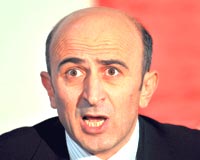
The clash of words between the justice minister and the YARSAV president carried the debate over the legitimacy of the association back to the agenda. " The act of judgment is the work of the independent judiciary. Neither myself nor any other person or institution can interfere with the work of the judiciary. YARSAV is an association. It doesn't represent the world of the judiciary," Şahin stated. Şahin's harsh remarks came shortly after a press conference held by Eminağaoğlu earlier in the day.
Eminağaoğlu's press conference denounced the latest wave of arrests which are part of the ongoing investigation into Ergenekon, a clandestine criminal network of groups and individuals accused of trying to overthrow the government. Thirty-seven individuals, including high-profile figures, were detained last week with suspected links to the criminal gang. The detentions have spurred reaction and criticism from some circles, led by the main opposition Republican People's Party (CHP) and some media outlets. Eminağaoğlu directed harsh criticism at the ongoing investigation, claiming the government was trying to turn Turkey into a police state, given the role of the police in the operations launched against the Ergenekon gang.
|

" The Turkish Republic is not a police state, and it will never turn into one," Eminağaoğlu said. He complained that the police had assumed the role of prosecutors and judges in the Ergenekon operations.
Şahin, in response, called on Eminağaoğlu to stop raising doubts about the impartiality of the judiciary with his reckless statements.
" As known, YARSAV is an association. It doesn't represent the world of the judiciary. The latest remarks of Eminağaoğlu gave me the impression that YARSAV has finally become YARSAP, namely the Judges and Prosecutors Party. We used to hear such criticism [against the Ergenekon investigation] from CHP leader Deniz Baykal. Now, we are hearing the same from Eminağaoğlu," Şahin remarked.
This is not the first time ?ahin lashed out at the YARSAV president for his comments on politics and the judiciary. Earlier this month, the justice minister called on Eminağaoğlu to stop " casting a shadow" on the Turkish judiciary with his statements on politics. " As a citizen of the Republic of Turkey, I would doubt the impartiality of a prosecutor or a judge who was making statements on politics; therefore, our prosecutors and judges should avoid making such statements. If Eminağaoğlu likes politics, he may engage in politics through the political party of his choice. He may fulfill his wish to be a politician in this way. But, he shouldn't cast a shadow on the judiciary," Şahin stated.
The timing of the YARSAV president's statement has also raised eyebrows, as it comes at a time when many have been careful not to make any comments on the ongoing judicial process into Ergenekon. The Supreme Court of Appeals convened last week, soon after the latest Ergenekon detentions, but refrained from releasing a statement afterwards. Chief of General Staff Gen. İlker Başbuğ paid unscheduled visits to both Prime Minister Recep Tayyip Erdoğan and President Abdullah Gül last Thursday but declined to make a statement about the content of the meetings and the Ergenekon investigation. Supreme Court of Appeals President Hasan Gerçeker refused to make a comment yesterday on the investigation and detentions, saying it would be wrong to say anything related to the case as the judicial process is continuing. " It wouldn't be correct to say something about the case at the moment. The judicial process is ongoing. The law works everything out. This is all I can say," he stated.
The editor-in-chief of the Aksiyon weekly news magazine, Bülent Korucu, drew attention to a significant point related to the controversy surrounding the very existence of YARSAV. In an interview with Today's Zaman yesterday, Korucu underlined that there is a large debate over the legitimacy of the association. " As we all know, the Sept. 12, 1980 Constitution prohibits police officers, soldiers and judges from establishing associations. Though our law does not allow the existence of such an association among judges, YARSAV continues to exist, and its president keeps making statements on various issues," Korucu stated.
Korucu also expressed the opinion that Eminağaoğlu was attempting to unduly influence an ongoing judicial case, which is, again, against the law. " A prosecutor or judge cannot interfere in an ongoing case being handled by another prosecutor or judge. If he does, he causes anarchy within the law. YARSAV has hundreds of members, but Eminağaoğlu makes a statement in the name of all of its members. This is not correct. Eminağaoğlu can only make a statement in his own name or in the name of the entire association, provided that the statement is approved by all of its members," he remarked.
Eminağaoğlu was at the center of a heated debate last August, when a Turkish daily uncovered a falsified medical report which showed that he was unfit for military service and was accused of evading compulsory military service. Eminağaoğlu, in his defense, stated that what appeared to be a falsification in the health report which exempted him from military service had been caused by a typing error.
Sacit Kayasu, a former prosecutor who was permanently disbarred after seeking the indictment of former Gen. Kenan Evren, the leader of the Sept. 12, 1980 military coup, drew attention to the inappropriateness of prosecutors or judges being affiliated with an association.
" Being a member of an association means showing one's political leaning and thus, losing impartiality. Judges and prosecutors should not side with a political party or view. I was never affiliated with an association. If I was an active prosecutor now, I would refuse to be a member of a group or an association," he stated.
Kayasu also stressed that there is a heated dispute over the existence of YARSAV. " The Constitution doesn't allow judges or prosecutors to establish an association, but international covenants say the opposite. The existence of YARSAV may be against Turkish law, but it is not a problem with international covenants," he noted.


