

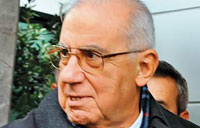
The recording includes revelations about the involvement of the retired general in three past military interventions. In the recording, the voice alleged to be that of Karadayı describes how the retired general assumed active roles in the coups of May 27, 1960 and Sept. 12, 1980, as well as the unarmed military intervention in 1997.
" He absolutely has to be tried," Mustafa Şentop, an associate professor of constitutional law from Marmara University, told Today's Zaman in a phone interview. However, he noted that prosecutors may run into problems under the statute of limitations on the crimes, since it has already been 13 years since the 1997 incident. " However, even for that to be understood, an investigation has to be started. Also, the statute of limitations on crimes known as recurring crimes -- crimes that take place more than once and have consequences that persist longer or come later -- are different. This could be considered a recurring crime," he said, repeating that a court would have to review the indictment first.
Not only Karadayı, but all actors in the Feb. 28 process should be tried, Şentop said, stating that this weekend some newspapers published more documents proving the involvement of other generals in the Feb. 28 intervention.
Former military judge Ümit Kardaş, who spoke to the Star daily on Sunday, said: " The person who has said these things [in the recording] should be tried under Turkish Penal Code [TCK] Articles 309 and 311. They have sworn to eradicate the Constitution and Parliament."
Law professor Hüseyin Hatemi said: " An investigation into this must be started, but I don't know if there is such a prosecutor in the country. Previously a prosecutor prepared an indictment against those who participated in the Sept. 12 [1980] coup, but he was removed from office.
There is no guarantee today that if a prosecutor indicts Karadayı, he or she will not be removed from office."
Sacit Kayasu, the prosecutor who indicted retired Gen. Kenan Evren for his role in the 1980 coup, was removed from office and disbarred.
Şentop did not agree with Hatemi. He said the ongoing trial into Ergenekon, a clandestine terrorist organization nested within various civilian and state agencies, including the military, charged with plotting to overthrow the government, was very encouraging.
He also called on Parliament to act and change Article 15 of the Constitution, a clause that protects the perpetrators of the Sept. 12, 1980, saying it has a symbolic meaning deterring prosecutors. Parliament should also change legislation to remove any statute of limitations for coup-related crimes, he argued. " Because it takes at least a decade before things normalize after a coup, there should be a law that explicitly states that there is no statute of limitations for anti-democratic interventions," he said.
Other Feb. 28 crimes
On Saturday the Taraf daily published scanned documents indicating the involvement of retired Deputy Chief of General Staff Gen. Çevik Bir in the 1997 military intervention. In the documents, some allegedly handwritten by Bir himself, and others published, specific orders are given to members of the military to keep commands and instructions received as part of the Feb. 28 plans ultimately confidential and to destroy them after reading. In a handwritten notice dated May 6, 1997, Bir informs members of the military commands and War Academies that Turkey has successfully dealt with the threat of terrorism, but that the threat has been replaced by religious reactionaries as the major danger to the country's future. The note says religious fundamentalists are trying to infiltrate the Turkish Armed Forces (TSK) and that the same group is also taking advantage of the country's freedoms and bringing the public under its influence with the media. The notice claims that the religious National View Foundation is training soldiers to create an Islamist army. It also says 493,000 poor children are being trained in accordance with the terms of Shariah, or Islamic law. The note predicted that in 2005 the percentage of religiously oriented voters would reach 67 percent.
In its Sunday edition, Taraf published an eight-page report issued by Gen. Mehmet Şanver suggesting that the Feb. 28 unarmed intervention, also referred to as Turkey's postmodern coup, continued behind the scenes after the overthrow of the coalition government led by the Islamist Welfare Party (RP) in 1997. Taraf's documents showed that the military made blacklists of entire neighborhoods, associations, unions, even kindergartens, coffeehouses, hospitals and pharmacies labeled as Islamists. These military reports listed agencies, companies and individuals and their affiliations, such as " belongs to the Naqshbandi sect's menzil group." The daily also noted that retired Chief of General Staff Gen. Hüseyin Kıvrıkoğlu had said, " The Feb. 28 process will last a thousand years," shortly after the overthrow of the government.
Details on Karadayı voice recordings
The recording released on Friday is not the first time a voice recording allegedly belonging to Gen. Karadayı has made its way to news Web sites. In a voice recording of Karadayı posted on the Türk Time Web site in late January, Karadayı tells another person that he had asked Motherland Party (ANAVATAN) leader Erkan Mumcu not to attend a presidential vote in Parliament in 2007 to ensure the annulment of the presidential election.
In the recording posted on Friday on the Haber7 Web site, the voice admits to having played an active role in all of Turkey's military takeovers. It also describes in detail how Necmettin Erbakan, the prime minister of a coalition government overthrown by the Feb. 28 intervention, resigned and how the government was presented to Mesut Yılmaz, a former ANAVATAN leader, " on a silver platter."
In addition to his deeds in the Feb. 28 coup, the voice in the recording explains that he was assigned to an army post in Ankara's Mamak district on Sept. 12, 1980, and says he was the " man who did the operation in Ankara." He also talks about the support universities gave to the military during the May 27, 1960 coup, adding that the military had dismissed academic Kemal Alemdaroğlu from his post at a university at the time. Ironically, Alemdaroğlu is currently standing trial as a suspect in the investigation into Ergenekon. E. BARIŞ ALTINTAŞ İSTANBUL


