

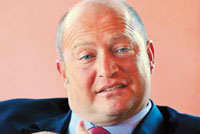
Mustafa Koç, the chairman of Koç Holding, underlines this fact and hints that the company will not hesitate to exploit any merger and acquisition opportunity. " Our cash position gives us the chance to chase opportunities abroad in the sectors that we focus on, and to take steps to become international players," he said during an exclusive interview with the Sunday's Zaman last week.
He was quite confident as he expressed his opinion that the company will definitely continue to be cautious and avoid risky investments. " But we will try to do our best to utilize the opportunities to consolidate and purchase in the global platform," he added.
The successful manager shared his remarks on a wide range of topics stretching from the ongoing investigation of the Ergenekon network to the economic crisis, and from the investment plans to rumors which might have affected the holding's popularity among Turkish consumers.
Do you think the crisis has affected the holding's targets?
We attained a near 42 percent increase in our average annual revenue between 2002 and 2007. And, encouragingly, we managed to increase our revenues by 43 percent in the first nine months of 2008 amid much harder conditions. We have been able to break into the top 200 companies in the Fortune Global 500.
However, the crisis is, of course, affecting our business, just as it has damaged every sector and company. So we are trying to offer the best possible service and conditions to our workers, customers, partners and shareholders, by managing risks and by taking all the necessary measures, with an awareness of the fact that this process will be a difficult but, ultimately, temporary one. The depth of the current crisis and its penetration are highlighting the necessity to increase savings, be more cautious and -- most importantly -- make sacrifices. Nevertheless, we are continuing to focus on the future and trying to create the best solutions for our shareholders without losing our confidence in the growth potential of our country.
We are a great family with more than 80,000 workers. I strongly believe that this family will weather the current hurdles without having to shrink, without taking arbitrary or slipshod decisions and with the maximum amount of altruism.
What type of measures has your company taken to avert the crisis?
We think the effects of the crisis will continue during 2009 and assume that both exports and the domestic market will contract by 20 percent. So we have prioritized such decisions such as focusing on savings from general expenditures, paying more attention to productivity, advancing in new exports markets and devoting our scarce resources to finish new product projects on time and in accordance with this assumption.
I think the government should take steps, as a short-term solution, to reinvigorate the economy, raise liquidity, decrease the costs of loans, stimulate the domestic market and support exports, especially to the markets that were hit least by the waves of the crisis. Besides, any initiatives the government has to protect skilled employment must not be delayed.
How would you define the crisis?
Although this crisis shows signals of the dawn of a period of stagnation, Turkey is still displaying the potential to grow strongly in the middle and long term. Everyone must take responsibility to deal with this crisis so it causes the least amount of damage and minimizes deviation from the long-term growth model. As Koç Holding, we managed to sign an agreement for a $700 million syndicated loan with the participation of 10 foreign banks during this turbulent period. This was an indication of the confidence in our country and holding; moreover, we have not made any change to our investment plans for now. We are not planning to interrupt our planned investment schedule.
Many in Europe say Turkey should be accepted into the EU because it was affected by the crisis less than many others. How would you evaluate this argument?
Actually, there was no need for a crisis to say this for Turkey. Everybody knows the market potential in Turkey, the quality of its products. The current account deficit, the biggest problem in the Turkish economy, is declining. The Turkish banking sector went through difficult times after the 2001 crisis. This helped the Turkish financial sector become more resilient to problems than ever before. It has become one of the few strong and well-established financial systems in the world. We are relieved by such facts to some extent. If the government can succeed in increasing the confidence and morale in the domestic market and sign a loan deal with the International Monetary Fund (IMF) before it is too late, the Turkish economy will be able to overcome the crisis' effects faster. People think they should cut expenditures as much as they can for the next three to six months and then they can meet most of their demands later; however, when you look at the current situation, we need people to spend and there is no need to wait.
Have we overcome the crisis yet?
It is hard to know for the time being. One of my friends from the US told me last week that almost 95 percent of the banks in his country have gone bankrupt. Before the crisis, in the US, you could not purchase a car with cash in your pocket. The companies encouraged people, even those who were in poor financial conditions, to use layaway plans. The problems increased and exploded at the end.
But some managed to stay alive?
Of course, if one side loses it means there is a winner on the other side. Similar to this famous saying after Sept. 11, 2001: " Nothing is going to be the same as before." However, this does not necessarily mean that the world is going to do away with the market economy. The automotive industry in the US is controlled by the labor unions. When you compare the US automotive industry with that of, for instance, Japan or South Korea, you see that the car industry in the US was operating artificially during the last few years. Serious changes are expected in the automotive industry in the US. We will see mergers and this is inescapable.
Do you agree that capitalism has collapsed?
No, I disagree with that. But there will definitely be some changes in the system. The wages of the managers will be revised, for instance. There will be significant alterations in the US economic system. American society expects a lot from the new government. We will wait and see.
When do you think markets will start tidying up?
I would say Turkey will be lucky if it can manage to end this year with a 1.5-2 percent growth rate, speaking realistically. There will not be a recovery in the first and second quarters. There will be some recovery only by September. Turkey may see growth in the economy in the third and fourth quarters. When you look at our business, in particular, it depends on customer demand. We can see continuous growth in September and October. But I cannot say the same thing for Western countries. They will struggle with the crisis for at least the next two years.
Do you expect this stagnation to change into something different in 2010 and 2011?
I do not think there will be a problem for Turkey. But there is a recession throughout the whole world. There will be a decline in demand, especially in the US and Europe. This situation will presumably last until 2011. But I hope that, in the end, we will fight back and continue growing, as in the past.
Family to continue running company for at least for two more generations
Two more Koç generations to run company
Do you still remember the day when you were told that you were the new chairman? Were you expecting that?
Indeed, Rahmi bey [his father] told me about it six months before my appointment. I made a verbal agreement with my father at the time, asking him not to leave the company for two years. That was my request.
Do you still consult with your father?
Of course, it's inevitable. He has many years of experience. Vehbi bey [the founder of the holding] did the same with my father, too.
Does he ever say you're going in the wrong direction?
No, but there are frequent differences of opinion. I believe this is very healthy. The important thing is what most benefits the company.
Koç Holding is the most successful family company in Turkey, but everyone wonders about what's going to happen in the future. Surely you have some predictions about this?
Are you sending me away? (smiles)
No, I wanted to learn if you were scratching your head over that.
The fourth generation is still too young.
It is commonly argued that one of the reasons behind this crisis is the fact that entrepreneurs are transferring the management of their companies to professionals. So do you think your family leaving the job of running the company to professionals is merely a dream?
We currently own 80 percent of the company, so it is extremely hard to turn the business completely over to professionals regardless of how strongly you embrace the principles of corporate governance. This will happen in the sixth generation, perhaps, if the company's overall shares fall below 5 percent, as happened with Ford, Siemens and Toyota. Indeed, the return to family companies has started once again. But this doesn't mean a setback in the attempts at institutionalization. We also have a " constitution" of our own, and the final decision is eventually made by the board of directors.
Children related by marriage are not able to have a managerial position in the company, are they?
We want to see the most appropriate professional managers occupying managerial posts to the greatest extent possible. We have goal in order to keep the company at top value. We have decided that this basic principle is hard to achieve when family members are overly involved. They can establish their own companies if they so desire.
'We were hardest pressed during the Yapı Kredi acquisition'
What is the operation that has challenged you the most since you took over the holding's top position?
One of them was the purchase of Yapı Kredi Bank. It started at 11 a.m. on a Sunday morning, and it was after 11.00 p.m. when we emerged from the hall. And the sale of Migros was also a very thorny process. We stood determined against very fierce resistance inside the family against its sale.
What was Rahmi bey's opinion?
He understood what we were trying to do since he already had a great personal interest in Migros. There were some sentimental moments, too, especially amongst the old managers of the company. They were insisting on not selling Migros sin ce they had exerted great efforts to grow it. Just we were succeeding in convincing them of the necessity to sell, friends of our family members were diverting their attention with questions like " Why are you selling such a company?" They were getting confused again, and we had to start from the beginning to persuade them.
Weapons found during Ergenekon investigations raise questions
There are ongoing heated discussions concerning the Ergenekon trial. On the one hand, bombs and guns have been found, while on the other, people are reacting harshly to the prosecution. How do you see these developments?
I am really confused by the latest developments concerning this Ergenekon issue. OK, there is a deep state organization here, dark relations similar to the Italian Gladio. We experienced the Susurluk event, and no one could find anything after all these years. If one looks deeply into the issue, many things will be discovered. But no one has touched it. I think we should separate the Ergenekon of before the guns were found from the one after. What kind of military coup can these people lead? Will a number of retired generals be able to do this? For God's sake, are these things so easy to do?
What about the discovered weaponry?
It makes one wonder. There is, of course, the fact that some suspicious organizations are permeating the state and the current system seems to be allowing this to happen.
What about retired Gen. Veli Küçük and Alparslan Arslan, who was convicted of an attack on the Council of State, appearing in the same photo?
That is a mystery. There are people who have been in jail for one-and-a-half years now and who do not know why they are there. This results from a malfunctioning judicial system. Also, the murder of Hrant Dink, and before him the murder of Üzeyir Garih -- these are all complex issues.
What do you suggest? Is every single citizen not equal before the law?
Surely we have to be sensitive about preserving equality before the law. The positions of the people are not important. It seems that we need reform in the judicial system.
Public has misconceptions about us
Let me first say Turkish society holds inaccurate ideas about us. We did not want to go out and say, " No, we are not as you think we are." Many people in Anatolia said they actually lacked knowledge about us during our visits to various provinces. We have decided to approach public relations by using a scientific methodology. People can learn about us through that. There are many things we should do. For instance, I learned that many people thought we were Jewish. Think about this, some people distort things on purpose. Shall I step up and yell in public, " Thank God I am Muslim" ?
Do you remember any of the old religious festivals?
Two things: We either went on vacation to Uludağ, or we visited relatives. Also, we went to Fatih Mosque every third Friday of Ramadan, as requested by Vehbi bey. We prayed the Friday prayer there and gave our " fitrah" (alms every affluent Muslim has to give to the poor and needy during Ramadan). You have to see the faces of people there when they watch us to see if what is happening is really true.EKREM DUMANLI / TURHAN BOZKURT İSTANBUL


