

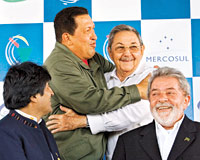
"We should give the new government of the United States a deadline in order to end the embargo,"said Morales, who kicked out the US ambassador in September over a different issue. "If the newly elected US government does not lift the economic embargo, we will lift their ambassadors out of our countries."
Latin American leaders, including those from Mexico and Colombia, which have been at odds with Cuba for years, rallied around Castro, who replaced his ailing brother Fidel as Cuba's leader in February. But Morales' call for breaking relations with Washington found little support. "I'm more careful than Evo Morales,"Brazilian President Luiz Inacio Lula da Silva said. "We have to wait for the new US president to take office and see what his proposals are for Latin America and Cuba. This will show us whether there was really a change."
Obama said during his campaign that immediately after taking office on Jan. 20, he would lift all restrictions on family travel and cash remittances to Cuba, but that he would not lift the embargo until he sees "significant steps toward democracy."
A spokeswoman at the US Embassy in Brasilia declined to comment on the Morales suggestion.
"Our policy toward Cuba seeks the promotion of the peaceful transition to democracy,"said Orna Blum.
Few concrete results came from the two-day gathering, held on the sun-drenched coast of Bahia state in northeast Brazil. The summit came 178 years after the Dec. 17, 1830, death of South American independence leader Simon Bolivar, whose name was repeatedly invoked at the meeting.
Mexican President Felipe Calderon suggested a new organization -- which he labeled the Union of Latin American and Caribbean nations -- should be created to tackle political and economic challenges. He said it would exclude the US and Canada and model itself on this week's summit.
AP COSTA DO SAUIPE


