

Oktay, who was found critically wounded in his automobile in Ankara's Çankaya district, was taken to the Gazi University Hospital, where he was pronounced dead. Police found two guns in his car. Oktay's body was sent to the Forensic Medicine Council for an autopsy. His remains will be sent to his hometown, Malatya, for burial after the autopsy. Oktay was married with three children. Officials from the Ankara Police Department said an investigation was launched into the incident.
Oktay served as the head of the National Police Department's Special Operations Unit for 13 years. He had replaced İbrahim Şahin, who is currently under arrest for membership in the terrorist organization Ergenekon. Şahin was arrested last month on charges of having established death squads containing members of the police force to assassinate prominent intellectuals, businessmen and non-Muslim community leaders in various cities across the country.
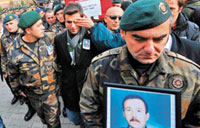
 Behçet Oktay, the head of the National Police Department's Special Operations Unit, shot himself yesterday in Ankara. A memorial ceremony was held for Oktay at the National Security General Directorate. |
Oktay's name was pronounced in testimonies of two Ergenekon suspects. Special Operations Unit Elazığ Director Ayhan Atabek and head of the Special Operations Unit Antalya branch Servet Kaynak, who were arrested on charges of membership in Ergenekon in late January, stated in their testimonies that they met [İbrahim] Şahin through Oktay.
Atabek and Kaynak are accused of serving in Şahin's death squads. "Upon a directive by Oktay, we thought we were given an official duty by Şahin," the two said.
Oktay's father, Muhammet, 78, was hospitalized after he heard about his son's death. Sources said Oktay's mother, Münüre, had died only six months ago. Oktay had been awarded the Turkish Armed Forces (TSK) Medal of Distinguished Courage and Self-Sacrifice.
There were rumors that Oktay committed suicide after he was dismissed from his post recently. The Interior Ministry, however, denied the claims, stressing that allegations that Oktay was removed from his position were groundless.
Behçet Oktay |

Oktay's death came only weeks after the suicide of an alleged member of JİTEM, a clandestine and illegal gendarmerie intelligence unit whose existence has thus far been officially denied, bringing the question to mind of whether he could have killed himself out of fear of being detained as part of the Ergenekon probe.
Col. Abdülkerim Kırca was found dead in his Ankara home on Jan. 19. There were claims that Kırca was behind hundreds of unresolved murders committed in Turkey's East and Southeast in the '90s. An upsurge in the number of unresolved deaths in the region does coincide with the term he served in the region.
Analysts, however, avoided drawing a link between the Ergenekon probe and Oktay's suicide. İhsan Bal, a member of the International Strategic Research Organization (USAK), an Ankara-based think tank specializing in the study of terrorism, said there was no immediate evidence to link the death of the head of the Special Operations Unit to the Ergenekon investigation.
"The reason behind his death is still not known. He may have killed himself for any tragic reason; maybe because of a problem in his private life or with his family. It is too early to link the suicide to Ergenekon," he said.
Mahir Kaynak, a terror and intelligence specialist who previously worked for the National Intelligence Organization (MİT), agreed, saying there was no strong evidence to connect the suicide of Oktay and the Ergenekon probe.
In the meantime, sources said Oktay was accompanied by a close friend of his when he killed himself. "While he was driving home, the car became stuck in the snow. Oktay was very angry. He started to yell about why he was constantly faced with such troubles. He took out his gun and shot himself in the head," the man reportedly said. He was later taken to the Ankara Police Department to provide a statement on the incident.
A memorial ceremony was held for Oktay at the National Security General Directorate, which was attended by a number of high-ranking state officials. Among them were Interior Minister Beşir Atalay, National Police Chief Oğuz Kağan Köksal and Gendarmerie General Commander Gen. Atila Işık.
In his memorial address, Köksal said Oktay was a hero who strived to serve in the best way for his country. "Everybody liked him. I'd like to say that such an end did not suit this hero. He was one of the rare personalities that has come through the police service," he noted. BETÜL AKKAYA DEMIRBAŞ İSTANBUL


