

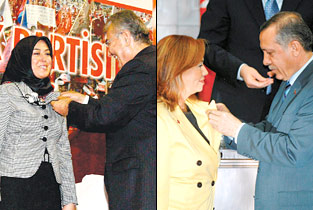
The transformation in discourse is also reflected in transfers of members between Turkey's major parties, shaking traditional balances established in the country's political scene.
As only a few months are left before the elections, political parties have sped up preparations to gain greater support from the public. Among the groups of voters for whom new initiatives are being prepared are conservatives and Alevis, both of whom have the potential to influence the outcome of the elections. Several political parties have devised plans to win over these groups.
Even core issues, about which political parties have had unchanging and well-known stances, are being discussed in an entirely new light by politicians from whom observers would least expect such things. The Republican People's Party (CHP), known for its unyielding stance on secularism, is recruiting women in chadors. The conservative Justice and Development Party (AK Party), which has long appealed to moderate and religious conservatives alike, is taking steps that would appeal to the country's Alevi community, whose members have overwhelmingly voted for the CHP since the establishment of the republic. Some of the new moves and unexpected initiatives by the AK Party and the CHP to lure voters ahead of the local elections seem to go against the conventional norms of Turkish politics.
It all started with CHP leader Baykal's unexpected U-turn last week from his longstanding hostility toward the Islamic headscarf when he honored women in black chadors with CHP badges. The sudden change in Baykal's attitude toward conservatives in the society was the first hint of an unusual shift in the norms of Turkish politics.
Though criticized even by some his own party's supporters and members, Baykal has so far stood behind the new " opening up" of the CHP to embrace segments of society that it has traditionally chosen to exclude.
At his party's parliamentary group meeting on Tuesday, he asserted that the chador was no longer a political symbol and that wearing it should not be seen as a form of opposition to the state. " Seventy percent of the women in Turkey cover their heads. Along with this is a small number wear the chador. What's the CHP's case? As the CHP, are we at odds with covering? Is the thing that covers a woman's head our opponent? Our enemy?" he asked.
With his new approach to covered women, Baykal received support from Prime Minister Recep Tayyip Erdoğan, who said: " If this is a truly genuine initiative, then I do congratulate those behind this change. This is also an awakening. They are starting to understand Turkey, with all its realities. This is a good development."
The CHP is not stopping at the chador move, according to sources, which say the CHP has plans to appeal to religious communities that are not happy with AK Party rule. Statements from CHP Chief Accountant Mustafa Özyürek and Secretary-General Cevdet Selvi emphasize that the CHP is ready to " embrace all 72 million in Turkey."
Discourse supported with transfers
Following his chador move, CHP leader Baykal, in a unexpected move, recruited Ercan Karakaş, a former Minister of Culture, who currently heads the Social Democracy Foundation (SODEV), and Arif Sağ, a folk singer to the CHP. Baykal has been criticized during the many years he has been at helm of the CHP for gradually eliminating the party's traditional left-wingers and socialists, a group which included many of his supporters, and establishing an almost totalitarian grasp over party leadership. Sources say the CHP is currently trying to convince the deputies and mayors of the Democratic Left Party (DSP) to join the CHP. The party hopes to convince at least 20 DSP mayors to run as CHP candidates in the local elections in March of next year.
The CHP also has plans to win the mayor's office in the capital. To achieve this goal, he has recently made an agreement with former Social Democratic People's Party (SHP) leader Murat Karayalçın, who will run as a CHP candidate in the local elections. With this, the CHP is expecting to increase its share of the vote to 30 percent in local elections. The party will seek similar transfers and candidates in the cities of İzmir, Gaziantep, Kocaeli, Mersin and Antalya, sources close to the party administration say.
Earlier this week, members from the traditionally right-wing Motherland Party (ANAVATAN) and Democrat Party (DP) joined the CHP. During the CHP's parliamentary group meeting on Tuesday, several ANAVATAN mayors announced their resignations from their parties in favor of the CHP. Among them were Taşdelen Mayor Hüseyin Sipahi, Güzelburç Mayor Behçet Şahutoğlu, Marmara Ereğlisi Mayor İbrahim Uyan and Akçalı Mayor Ali Sabahoğlu. The ruling AK Party's Temelli Mayor, Alattin Türkoğlu, and the DSP's Eşme Mayor, Ahmet Yıldırım, also joined the CHP.
However, the CHP has not been alone in its ventures into unfamiliar territory. Baykal's recent move to welcome covered women into his party was followed by the AK Party's new initiative regarding Turkey's Alevi community, a religious community with an estimated 6 to 12 million adherents in Turkey. Following a Cabinet meeting last week, the ruling AK Party announced that concrete steps would be taken to meet the demands of the country's Alevi citizens. As part of the new initiative, Alevi dedes (religious leaders) will be granted a monthly salary. The amount of their salary will be decided following discussions between Alevi associations and government officials. In addition, the electricity and water bills of cemevis (Alevi places of worship) will be paid for by the state. The AK Party is also planning to make state-run religious courses, which tend to focus on Sunni Islam, non-compulsory. Starting from 2009, the Ministry of Education will make the necessary changes to the courses' curriculum. Alevis claim that forcing children to attend the compulsory religion courses violates individual rights and freedoms and say they should be abolished.
The AK Party aims to erase ANAVATAN and the DP -- whose traditional voters make up a significant part of the AK Party's votes -- from the Turkish political scene entirely. Sources close to the AK Party say the ruling party is trying to fend off a potential marriage between these two parties. The ruling party has managed to convince several DP mayors, including Elazığ Mayor Süleyman Selmanoğlu, İbradi Mayor Muharrem Kaya, Karacabey Mayor Ergün Koç and Gürgentepe Mayor Selim Ölmez, to join its ranks and hopes to recruit many others from these two parties.
New figures from the opposition Nationalist Movement Party (MHP) have joined the AK Party, as well. These include Kırklareli Mayor Cengiz Bağdan and Eynesil Mayor Coşkun Somuncuoğlu. With these new transfers, AK Party leader Prime Minister Erdoğan is hoping for an overwhelming victory in the approaching local elections.


