

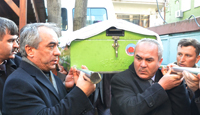
Ağar, who was police chief shortly before the 1996 Susurluk affair, is facing an investigation into his part in the unlikely arrangement between a famous mafia boss, a member of the security forces and a politician. The 1996 Susurluk affair exposed links between the Turkish state, the criminal underworld and Turkish security forces.
Ağar had successfully managed to evade investigation due to his parliamentary immunity over the past 12 years. In a statement on Ağar not showing up in court last month, the president of the parliamentary Human Rights Commission, Zafer Üskül, recalled that in testimony to a commission investigating the Susurluk affair many years earlier, Ağar had said, " I will talk if the state wants me to."
Ağar, a former interior minister and former leader of the Democrat Party (DP), was to be tried in November, but the court declared the case to be out of its jurisdiction and handed it over to the Ankara 11th High Criminal Court, which is responsible for hearing cases earlier handled by State Security Courts (DGM), which no longer exist.
Susurluk and Ağar trial background
Hüseyin Kocadağ, a former police chief, Sedat Bucak, a southeastern clan leader whose men were armed by the state to fight separatist violence, and Abdullah Çatlı, an internationally wanted mafia boss, were involved in an accident in 1996 near the small township of Susurluk while riding in the same car. Kocadağ, Çatlı and his girlfriend, a former model, were killed in the accident. No serious charges followed from the ensuing investigation, which had actually exposed, for the first time in modern Turkish history, a gang with links to the state. Retired Brig. Gen. Veli Küçük, who is currently in jail over suspected membership in a shadowy gang known as Ergenekon, was detained but then released in the Susurluk investigation. Küçük is not the only link between the Susurluk affair and Ergenekon, whose suspected leaders and members currently face charges of " membership in an armed terrorist group," " attempting to bring down the government," " inciting people to rebel against the Republic of Turkey" and other similar crimes.
In February of this year, charges were filed against Ağar for " establishing an armed organization for the purpose of committing crimes, failing to inform authorities of the whereabouts of a suspect, aiding and abetting, granting firearm licenses to Çatlı and Yaşar Öz in violation of the law, ensuring the granting of senior public servant passports to Çatlı and Öz in contravention of the law and dereliction of gubernatorial duty." Ağar, who served as governor of Erzurum in 1992, was appointed by then-Prime Minister Tansu Çiller as head of the National Police Department in 1993. He was the interior minister of the Çiller-led coalition government in 1996 until he was forced to resign after the Susurluk scandal.
Ağar was elected to Parliament in 2002, which gave him the protection of parliamentary immunity until July 22, 2007, when the party he led, the Democrat Party (DP), failed to pass the election threshold.


