

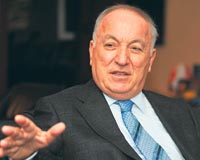

Speaking to Let's Talk Business, Yüksel Mermer, the CEO of Mermerler Group, which is Chery's Turkish distribution partner, said the Chinese carmaker is actively working on logistics for establishing a production line in Turkey. Mermer emphasized that Chery has not changed its plans with regard to Turkey after the global economic slowdown and that company executives are determined to open up to the European market by establishing a base operation in Turkey.
As Chery's exclusive distributor in the Turkish market for the past three years, Mermerler Group has invested a substantial amount of money to establish a dealer network and service centers and has provided training for technicians and servicemen, Mermer said. "Before we began distributing Chery cars, we set up service and spare parts centers across the country and built a dealers' network," he noted.
Mermer admitted that he was uneasy at first when dealing with Chery because of the common biases and misunderstanding in the media. "I completely changed my mind when I saw the plant in China that was equipped with the latest technology and machinery," he said. Recalling his visits to German and Japanese auto plants in the past, he said, "Chery's factory is a state-of-the-art facility." Chery's plant, which has a capacity of 1 million autos annually, in China uses German and American machinery and contracts with the Italian Bertone and Pininfarina companies, known for their designs for Ferrari and Lamborghini. Chery even signed an agreement with Ricardo Consulting Engineers to develop the first hybrid Chery model in the assembly line.
|

Although Chery has similar assembly plants already built or in the process of being established in countries close to Turkey such as Iran, Bahrain, Ukraine, Egypt and Russia, the investment in Turkey presents a distinct opportunity for Chery: unencumbered access to the European market because of Turkey's customs union agreement with the European Union. In fact Zhou Biren, Chery's vice president, on a visit to Turkey last year, said: "Being successful in Turkey will for us be a benchmark of our success in Europe. This is because Turkish customers have similar tastes to customers in the EU. For this reason, Turkey is the first step toward entering the European markets, which is our primary goal."
|

Safety standards are in line with EU regulations
When asked about concerns over safety and quality, Mermer said: "The group is bringing only the highest quality models that pass all safety and crash tests according to Turkish and European standards." So far, Mermerler Group has obtained authorization and permits to import four models of Chery vehicles. The models imported to Turkey also differ from the ones produced for the local market in China, Mermer revealed. "We asked the company to revise manufacturing and outfitting these cars based on test runs we had done in Turkey," he said. Cleaner fuel technology is among the upgrades. For example, on request from Mermerler, Chery has revamped 36 different aspects of the Tiggo model.
Building on two generations of family experience in the auto market in Turkey, Mermerler Group's stamp of approval for Chery is important for retailers in Turkey. The group managed Mazda distributorship for 22 years until the Japanese automaker decided to terminate its agreement and enter the Turkish market directly in 2007. "We are still major supplier of spare parts for Mazda cars in Turkey," said Mermer adding, "Without our support they could not survive here."
Since Mermerler's name is familiar among dealers, the group quickly promoted Chery and has expanded to 55 retailers across the nation in a little over two years. "We would like to open a car dealer in every city in Turkey," Mermer said, noting that the company expects to hit 80 dealers by the end of 2009.
The group set up a state-of-the-art logistics center in Kartal, on the Asian side of İstanbul, as a $20 million investment to serve the growing need for spare parts in the auto industry. It also operates a training center for technicians and dealers. "What we hope to accomplish is that we can expand our market to neighboring countries in the region and can manage spare parts demand from here," Mermer explained.
|

The center is equipped with an automated inventory retrieval system, and a dealer can order a part directly from the shelves. The strong industry in Turkey for automotive spare parts is another reason that Chery picked Turkey as a base country. "They would like to use the country's well-established auxiliary industry to their advantage," he said.
Mermer said he was encouraged by the feedback the group has received from customers so far. "Our loyal customers are bringing their friends and relatives to buy another car from a dealer lot," he said. "Considering that we are competing with well-established brands and strong dealers, I think this indicates a promising future for Chery." Mermer emphasized that each Chery model carries a three-year and 100,000-kilometer warranty unlike many German cars that offer a two-year and 60,000-kilometer warranty. "We also support spare parts service and promise to provide any part within 24 hours in contrast to the 48-hour wait time for other brand names," he noted.
Price tag starts from TL 20,000
Chery models in Turkey, Alia and Tiggo, have a sticker price of TL 20,000 to TL 40,000, including taxes -- 30 percent cheaper than comparable brands. "It could be much cheaper," Mermer said. "But we have to pay an extra 10 percent for the import duty imposed by Turkey on non-EU countries like China." This is on top of the 37 percent private consumption tax (ÖTV) and 18 percent value added tax (KDV). Mermerler also factors logistics and transportation costs into the price. For example, the pre-tax sticker price for a Tiggo luxury model with 1600cc engine costs TL 27,731. With taxes, it goes to TL 39,990.
Mermer aims to put Chery among the top-10 auto brands in Turkey and would like to see more models coming to the Turkish market as soon as authorizations are received. As of November 2008, the company sold 1,744 cars, putting Chery in 24th place in the Turkish market, leaving behind many known brands like Mitsubishi, Mazda, Chrysler and Saab. Though he declined to provide names, he conceded that the Mermerler Group is looking at other brands in the future. "It is not as easy as it seems to be," he said. "It takes a long time, lots of investment and preparation."
The crisis has already started to take its toll on the auto industry in Turkey. "Since most car sales are directly related with credit and financing, we see a sharp decline in sale figures," Mermer said. As the global economic slowdown hits home, it is not easy to get a loan or financing for a new car. The group is expecting a new set of regulations from the government to encourage auto sales.
Mermer is especially hopeful on incentives for replacing older model cars. The incentive would provide tax breaks for older model car owners when buying a new car from a dealer's lot. Mermer pointed out that 25 percent of all cars in Turkey are more than 20 years old and 55 percent are more than 10 years old. Incentives will encourage consumers to replace older models with cars that have better technology, fuel efficiency and safety records. The move makes sense as recent data showed 162,000 cars out of 566,000 failed initial inspection tests conducted at private inspection facilities between January and October 2008.


