

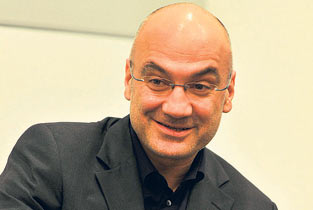
An increasing number of commentators are now pointing to Microsoft as having become too big and bureaucratic to flexibly respond to the breakneck speed of developments in the global information technology (IT) market. Çağlayan Arkan, General Manager of Microsoft Turkey however sees boundless opportunities in store for microsoft in Turkey.
In part to challenge these claims, Microsoft has recently announced its implementation of the new Microsoft Azure Services Platform -- which it describes as an " Internet-scale cloud services platform hosted in Microsoft data centers, which provides an operating system and a set of developer services that can be used individually or together." In other words, it is a virtual operating system, services platform and database, which Microsoft expects is where the future of software lies. To facilitate this, Microsoft has announced plans to build 12 global data centers with a price tag of half a billion dollars apiece.
The corporation's İstanbul office serves as the headquarters for both the Middle East and Africa region as well as for Turkey. Sunday's Zaman recently had the opportunity to speak with Çağlayan Arkan, the general manager of Microsoft Turkey, and learn his thoughts on the future of Microsoft in Turkey as well as well on the challenges and opportunities that lie ahead for the industry. In this crisis environment, Arkan feels that Microsoft's superior software is its strongest asset and promises to save the private and public sectors billions.
How is the crisis affecting Microsoft?
Given our diverse portfolio, there are different levels of impact. If you look at the retail, it's the highest impact area because the consumer does not have a big appetite for buying and also given the charges with the credit cards and the credit card payments and increasing payments, this looks poised to slow down.
If you look at the SME [small and medium-sized enterprise] space, things have slowed down, but by a range of about 10 to 15 percent. If it is not up to our expectations, there is still growth there, and there is still commercial activity going on.
In the enterprise space and the public sector space, the commercial activity is going on, maybe not at full speed, but close to it. Sales cycles have grown longer, but in the way of demand and investment enterprises' appetite for investment into technology and seeking business productivity ... it is still there.
Interestingly enough, there was a paper in the US talking about the software industry shrinking as a whole except for Microsoft because we are so competitive and we offer great value, particularly to the enterprise space and the SME space. That report foresaw a scenario where Microsoft was commoditizing the enterprise data center and bringing a lot of value and a lot of savings in terms of daily operation. We can't imagine a bank cutting down technology investment nor such enterprises as utility companies because there is a need for a competitive advantage. Therefore they will have to keep making investments, and this is what we do in terms of our value position.
There's also this talk of 'cloud' servers and cloud software becoming harder and harder to sell. How do you see this developing in the next little while?
It is happening; it was a long-awaited development. As a company, we look forward to MS leading this new era as well. ... We have made investments into 12 global data centers with a $500 million investment each. Each will be the size of 15 soccer fields. This, of course, will be important because it caters to the consumer. We have already declared that we are migrating all of our software and services and products into the clouds. We have announced and launched our cloud competing services and windows for the cloud -- which we call Windows Azure. We now have now an operating system in the cloud and a set of services that enable development for the cloud, and the industry realizes now that Microsoft does not only compete with its Live brand. Everything we offer to consumer space from the cloud in the way of Internet services comes under the name " Live." So it is not only that space that we are competing, it is also the enterprise space. So today with Azure and the service and development there, the ISV [independent software vendor] and the software development companies that serve the enterprise companies, or the developer that works in the enterprise space, or Microsoft, will now be developing services and software in the cloud for enterprise users. For both of these, we are looking at a picture, where in the desktop there is a client that we believe will stay there. We believe there will be a lot of personalization and application in the client and then a lot of services and applications used by the same end-user from the cloud or on the cloud. And we reckon as far as enterprises are concerned, the data center will be there, some of the competitive and confidential data will still be in the enterprise data center, whereas there will still be a lot of services and architecture by the same enterprises in the cloud or through the cloud. So these are hybrid scenarios that we offer software plus services, so we believe that the existing software licensing models will remain, but there going to be a lot of offerings through the cloud. In both spaces, we are looking forward to being the leader.
With software in the clouds, will this cannibalize your existing software?
The sector is growing, and we think that what the cloud offers and the investments that we will make present higher growth opportunities in total as opposed to cannibalizing, at least as far as our core business is concerned. We keep getting market share in every front we are present in, except for search for the consumer. For enterprise, we are leading the search market.
In total, even in the face of the crisis, our market share growth projection is 10 percent.
Last year, we finished the fiscal year with $60.4 billion in revenue, with a $21 billion profit. With this year's guidance after T1 flows, which is the end of October, in the middle of the crisis, our new lowered guidance is $65-$66 billion revenue with $25 billion profit. This tells us two things: Even in the face of the crisis, we projected 10 percent growth and even higher growth in profitability.
How did you arrive at these numbers?
This is because of the value proposition. If the kind of value that we offer leads to the enterprise space in the way making them more productive, competitive decreased project times, very easy production cycles, very rich development environment, very user friendly development tools, interpretability, integration and security, which is now a big advantage for us -- we have come a long way from being vulnerable to information security now.
If you look at our unified communications offer, that dictates a lot of savings with marginal investments because that is only done with software. With the Microsoft scenario, you don't need to change any hardware, and you probably have those licenses anyway. So, you save hundreds of thousands if not millions of dollars by cutting down travel, traffic meeting times, etc.
If you look at virtualization offerings, we are now a very big contender of the server virtualization and leaders in application virtualization and desktop virtualization and so on.
Can you provide an example?
Let me give you the example of Digiturk. In Turkey, through our server virtualization investment, we were able to give them 80 percent increase in energy costs in the data center and a 40 percent savings in operating costs. These are very strong offerings.
If you look at the Vista and Office 2007 scenarios in terms of the information worker productivity and cooperation, we give the enterprise user a lot of end power and productivity and competing on the go.
What about work with the public sector?
We have a big investment in Ankara with the centralized government. There are different types of investments in the public space. But what we have not seen in a long time in the public sector is large-scale revolutionary investment in the public sector seeking to rationalize resources, for example in the health industry or in the social security industry. We think the IT industry can offer billions of dollars of savings there. Another example would be in energy, particularly with accounts receivable for private or public or for distribution companies.
We do not have many examples as a country making big investments in the public space, seeking productivity, seeking better quality services for the citizens. We think Turkey's development will come from the IT industry and investment in the info and tech space.
So to bring the two together, we have decided to make a Microsoft innovation center in Ankara. We started work a couple of months ago. The three focuses of the center will be health, education and local regional governance. And we will be inviting our potential partners to collectively invest and to have local applications and offering local values to the local market and the export of those applications and know-how. So this is where we will develop these applications for the public sector.
Do you have any specific partners that you can tell us about?
It's open to anyone who is willing to make the investment. Our part of the investment will be subject expertise. Say in the area of health, we will bring in health experts, health IT experts, system architects, project managers, methodology hardware infrastructure, software licenses and tools. We will expect the partners to come in with the idea, or the know-how, or the demand, and the developers. We will collectively develop applications there for them to sell to the domestic market or for them to export with us.
Any potential partners?
I can't name names. We already work with the Ministry of Health. So any partner who now is a competitive actor in the health sector is now intrigued by the potential, and we have started speaking with two or three of them to start the development process.
Do you foresee there being problems in having people consent to putting their personal information such as health records on the clouds?
We recognize the issues, and there will be many issues, and it's why we think it's not going to be a software as a service world where everything is in the cloud, and we think it is not going to be a software clusterless world, where some of the data and some of the applications will still be domestic in the Ministry of Health or in certain hospitals and some banks, but there will be applications in some data center clouds. And their use will be hybrid. And we, as a market leader and responsible company, will work on all the security and privacy and all related issues, and we will make a lot of communication and a lot of education about this.
Can you offer a parallel example of a country or company that has implemented these systems and saved billions?
If you look at what's happening in Iraq -- it might not be a positive example -- but what happened in the way of all the military operations and all the needs of mobility and the needs for security intelligence and operations, most of those operations operated on Microsoft platforms.
We believe this not only saves dollars, but also saves lives.
One example from Turkey is Arcelik -- one of the largest IT operations in Turkey. They were running large-scale enterprise resource and planning systems on another platform. We migrated that platform to Microsoft technologies for the cost of one year's maintenance and gave them three times more performance with the same application. This kind of savings is pretty much what we are talking about across the board in the enterprise space.
If you couple that with the Digiturk example, that is remarkable, and if you couple with that with the energy savings that Vista is offering in Garanti Bank or Fortis bank in Turkey, we are looking at about 25 percent savings from the energy that the desktops use. And so these are remarkable savings that we have enabled through migration to our platforms.
İstanbul is the head of the Middle East and Africa (MEA) region. What makes Turkey unique in Microsoft's global scope?
Turkey is part of two settings for Microsoft. One is MEA, obviously a geographic way of clustering operation in that space. Turkey is headquarters for the operations we run in 79 countries. So that gives you a flavor of how important Turkey is in this geographic structure.
From a market similarities perspective, we are part of large emerging markets cluster in Microsoft. Within the cluster sits Brazil, Russia, India, China, Mexico, South Africa and Turkey -- the seven largest, fastest-growing consumer markets in the world.
Turkey is the smallest in this cluster, but the leader for this cluster. So we are facilitating growth, best-practice sharing and working on new strategies. Turkey has long been designated as an accelerated growth country and a very important market for Microsoft.
When you look at Turkey, maybe you see an emerging market, but when you compare with India, where only 60 percent of the households do not have electricity or rooftops. If you look at Turkey, there is 110 percent TV set penetration, 100 percent washing machine penetration, the third-largest card market in Europe -- 65 million cards (credit, debit cards) and then four mobile [phone] subscriptions per household. All of this tells us that, yes, this is an emerging market maybe from a GDP per capita perspective, from spending indexes in several other industries or from an intellectual property rights perspective. But on the other hand, it is a very sophisticated consumer market with a very sophisticated banking and financial infrastructure, very sophisticated and well-covered retail industry. And very competitive. So that gave us a track record of the second fastest-growing [to Russia] in the large emerging markets cluster. From an excellence and execution perspective, we have been the best performer in this cluster.


