

Thirty-seven suspects were detained in the Ergenekon case last week, with 17 arrested and some others released pending trial.
Another 86 suspects are currently on trial, 45 of them being kept in custody at a prison complex in Silivri. Also in last week's operations, a number of arms caches belonging to the group were uncovered, including munitions found in the home of Lt. Col. Mustafa Dönmez. The serial numbers on grenades found in Dönmez's home are reported to be from the same batch as those found in June 2007 in a shanty house in Ümraniye that also belonged to an Ergenekon suspect. The matching numbers more clearly establish the links of the organization.
According to records from the year 1992, the grenades, manufactured by Turkey's state-run Mechanical and Chemical Industry Corporation (MKE), were delivered to the Turkish military. The batch number also matches those found on two hand grenades used in a bombing at the headquarters of the Cumhuriyet daily in 2007. The National Intelligence Organization (MİT) informed the General Staff at the time, according to reports from the organization, and the General Staff started a probe into the allegations, but it is not clear what became of the probe.
|

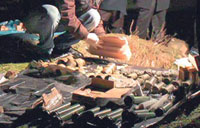
Earlier this week, another arms cache was found in the Zir Valley in Ankara's Sincan district based on a map found in the house of Lt. Col. Dönmez. Thirty hand grenades, nine smoke bombs and more than 800 bullets for G3 assault rifles were found there. Yesterday, two hand grenades were found buried inside a park in an industrial zone and were sent to a criminology lab for further examination. Nearly 200 bullets were discovered also on Tuesday night, in a vacant lot across from a housing complex in the OR-AN area formerly reserved for members of Parliament and their families.
Weapons and munitions found
The lieutenant colonel and other military officers' involvement in Ergenekon is no secret, but the public is demanding answers about the effort the General Staff has put into investigating its own personnel. It is not clear what, if any, conclusions have been reached in a number of investigations into military officers involved in alleged plots against the government.
In 2005 MİT established that there were officers meeting in what they called "grassroots houses" to devise plans to create chaos and foment an atmosphere in the country suitable for a coup.
The police on Tuesday carried out a series of digs at a number of sites around the capital in a search for weapons linked to the Ergenekon terrorist organization. The excavations are a continuation of earlier digs based on new documents obtained during police raids on the houses and offices of last week's detainees. Police on Monday discovered explosives and bullets in Ankara in excavations carried out within the scope of the Ergenekon investigation. They unearthed 30 hand grenades, nine smoke bombs and hundreds of G3 rifle bullets in the garden of a deserted house in Sincan. The hidden weapons not only give clues to the organization's planned attacks but also may shed light on past crimes believed to have been committed by the organization.
Tuesday's excavations started early in the morning in Yenikent, an area not far from the site of the cache found in Monday's digs. The excavation was briefly halted, as the area is a historical site, a status given to it only a week ago, but then was restarted when Turkey's Museums and Monuments Directorate gave the green light. Only the Anatolia news agency and the Turkish Radio and Television Corporation (TRT) recorded footage at the site.
An ancient jug was unearthed during Tuesday's excavation. Archeologists have yet to examine the artifact, officials said.
Sauna link in Ergenekon
Sources yesterday said prosecutor Zekeriya Öz, who has been assigned to the Ergenekon case, was examining the dossiers of the Atabeyler and Sauna crime gangs believing that these two gangs might be cells of the Ergenekon crime network. Col. Mustafa Levent Göktaş, who was arrested in last week's operations, was also implicated in the trial of the Sauna gang, whose members extorted money from politicians and bureaucrats through blackmail.
In a telephone conversation between two suspects, Göktaş is referred to as the commander of the War Search and Rescue Command (MAK) of the Special Forces Command. Former Col. Nuri Bozkır, who was also tried in the Sauna case, served in MAK as well. According to the recent phone conversation, Göktaş was a superior of Bozkır. Also, a large number of CDs found at Göktaş's house with footage showing senior-level bureaucrats in inappropriate settings with the opposite sex seems to suggest a link to Sauna, the police suspect.


