

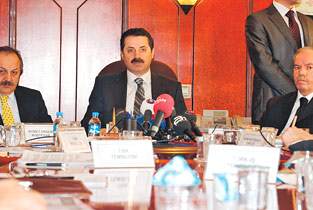
Asserting that slashing labor would diminish disposable income, the minister said these measures would backfire on the companies by causing further drops in their business. Speaking in the Minimum Wage Determination Commission's meeting on Wednesday, Çelik said employers must not see pushing workers to the streets as the first step to take in times of crisis. " This approach means failing to comprehend the crisis and to avoid having the determination to overcome it," he said.
" Pushing workers out the door is definitely not the right thing to do."
The commission, comprising 15 members -- five representing workers, another five representing employers and five from the government -- convened in Ankara on Wednesday to decide on the amount of the new minimum wage, which will go into effect Jan. 1. The current minimum wage is YTL 503 per month for workers over the age of 16.
The Confederation of Turkish Labor Unions (Türk-İş) attended the meeting to represent workers while the Turkish Confederation of Employers' Unions (TİSK) joined to express the opinions and demands of the Turkish business world. A quorum of 10 members is enough for the commission to convene, and decisions are made by majority vote.
The minister devoted a large part of his speech to concerns about unemployment. There is no need to use the unemployment fund right now, he said, but he added that some mechanisms might be put into action if needed after discussing the situation with worker and employer representatives.
" There is YTL 36.7 billion in the fund, and it may be spent to protect employment levels in the country with the participation of both sides in this issue and for temporary periods of time," the minister said. " But if companies continue dismissing their workers, supporting non-financial businesses from the unemployment fund becomes really hard."
Demand grows for short-time benefits
The minister's proposal regarding short-time benefits is not commonly known by companies. As the global financial crisis has started to shake non-financial industries, many companies are mulling the option of slashing labor costs either by dismissing workers or by temporarily sending them home with a leave-without-pay. Companies usually don't consider applying for short-time benefits beforehand.
In a TV program on Tuesday evening, expert on worker-related issues Ali Tezel warned workers not to accept unpaid leave, saying that this leave does not fall under any law. Instead, Tezel suggested that workers talk to company managers about submitting an application to the Turkish Employment Organization (İşkur) to start the process to receive short-time benefits.
In an interview in Referans daily on Wednesday, Çelik said that 17 companies have so far applied to İşkur for short-time benefits, which will be paid by the Unemployment Insurance Fund for more than 6,000 workers.
The short-time benefit is income support from the unemployment fund for temporarily laid-off workers. Companies are able to apply for these benefits only if they are facing tough conditions to continue running their business because of an economic crisis or other force majeure situations, like the halt of production in manufacturing plants because of a natural calamity. A company may either decrease the working hours by one-third or postpone production completely for a while.
If the Ministry of Labor accepts a company's application to receive short-time benefits, workers receive money from the state that totals no more than the minimum wage. The payment, under current conditions, varies between YTL 255 and YTL 503 depending on the worker's ordinary wage. The state continues its payments for three months at most. After this period, the company has to either start paying their workers' normal wages or dismiss them completely by paying their pensions.
Çelik said they might increase the duration of the payments and their amount depending on the conditions that arise during the days ahead.
İşkur's own figures show that 21 people received a total amount of YTL 10,566. In 2006, 217 people were paid YTL 64,398 in total and in 2007, 40 workers got YTL 22,051 as short-time allowance.
Underlining that everyone in the markets should act responsibly and avoid panicky moves, the minister estimated that the current troubles from the crisis will likely end in September or October 2009. He also advised companies not to be so impetuous in dismissing workers because it creates harsher consequences for companies than the ones they were avoiding, such as paying pensions and the costs of recruiting new workers once the crisis is over.
He also asked the worker unions to be more understanding and to be content with less while bargaining with employers. For example, the minister said, the unions should temporarily give up demands for perks such as four bonus payments in a year. Unions also have to share the responsibility in attempts to recover from the crisis, he added.
Commission working on new wages
The Minimum Wage Determination Commission is expected to come to a decision in several days. The minister said in his speech in the commission's meeting that the minimum wage has increased by 155 percent in the past five and a half years, during which inflation has risen 75 percent.
Ali Nafiz Konuk, the TİSK representative, wanted the commission to take the global financial crisis into consideration when deciding the new minimum wages but avoided offering an amount. Exports have already started falling and domestic demand is decreasing, leading companies to more troubles, he said, adding that labor unions must not be insistent with demands that might damage the companies' competitiveness.
Türk-İş Education Secretary Nihat Yurdakul, on the other hand, defended that the minimum wage provides leverage in raising the purchasing power of the society as a whole. He asked the government to exempt the minimum wage from taxation and wanted to apply the same minimum wage everywhere, opposing demands of some businessmen and government officials to apply lower minimum wages in impoverished regions.
Koç emphasizes qualified labor
Meanwhile, Mustafa Koç, chairman of Koç Holding, said the difficulty of finding a qualified workforce is as worrying as the problem of unemployment itself.
During a visit a vocational training school constructed by his company in Ordu's Ünye district, Koç and Dr. Bülent Bulgurlu, the CEO of Koç Holding, found some time to talk with Ünye District Director of Education Mehmet Gür and with teachers. After his visit, Koç spoke with the press to say that vocational schools facilities carry significance for industry because they train qualified workers.


