

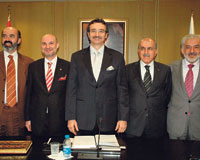
Tüzmen hosted the board members of the Independent Industrialists and Businessmen's Association (MÜSİAD), headed by MÜSİAD Chairman Ömer Cihad Vardan, at his office in Ankara yesterday. Speaking at the meeting, the minister praised MÜSİAD and other business groups for their integral role in bringing exports to annual levels of $130 billion and boosting foreign trade to $300 billion.
He estimated that contraction will be seen in the import of intermediary goods and that local industrialists will be more likely to meet their needs for such goods with domestic products.
In order to reinvigorate the business world in Turkey and inspire excitement among exporters once again, Tüzmen said his ministry has been working to diversify export markets by focusing more on the countries that have not sustained much damage from the global crisis. Thus, more attention is being paid to regional countries through the work of organizations such as the International Business Forum (IBF). The IBF was organized by MÜSİAD to bring thousands of businessmen, economy bureaucrats and statesmen from African and Eurasian regions together with a business platform for garnering new trade deals and partnerships. The minister explained that a number of official visits will soon be organized to assess and utilize business prospects in the Iranian and Egyptian markets.
" These markets will help us stand up and ensure the continuation of our exports' rising performance," he explained. The biggest hurdle in international trade now is contracting markets, he added, concluding that the new battle between nations will be over the preservation of share in shrinking markets.
Also speaking at the event, MÜSİAD Chairman Vardan said Turkish businessmen have always received great support from Tüzmen in their race to expand foreign trade activities, and he conveyed his thanks to the minister for his efforts to remove the barriers facing exporters.
He brought to mind last year's IBF meeting, which was attended by 23 ministers from 17 countries and 2,224 businessmen from 62 countries. He said 48 percent of the foreign participants had signed mutual deals with their Turkish counterparts.
Tüzmen later received a delegation from the Iron and Steel Producers Association (DÇÜD). Speaking to the group, he said his government plans to apply " smart policies" to decrease the foreign trade deficit in 2009 and 2010 in order to increase the competitiveness of Turkish businessmen against their major rivals in the global market. " There isn't much we can do to change the contracting external demand. So we have to focus on our own means to deal with the current difficult conditions," he said.
The minister spoke about the iron and steel industry's performance last year, saying it achieved great success by increasing its exports by 86 percent in 2008 over the year before despite adversities caused by the economic crisis. This is clearly an indication of the sector's skill, he added.
Speaking after the minister, DÇÜD Supreme Advisory Council President Halil Şahin said the sector had accelerated significantly after the first quarter of 2008 but started seeing serious drops in price and demand after August. He complained about the sector's relatively disadvantageous situation in its competition against Chinese, Russian and Ukrainian producers, such as higher energy costs and taxes, and asked the minister to help alleviate these conditions for the sake of enhanced competitiveness in the international arena.


