

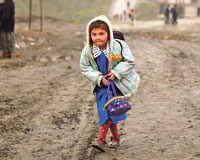
The ministry started a new campaign to increase enrollment in compulsory education to 100 percent. Of the 289,000 children missing out on mandatory education, 171,000 are girls. As part of the campaign schools were visited from province to province to obtain the names and addresses of children who were not enrolled in each and every neighborhood. After the "door-to-door child school registrations," out of 326,000 unregistered children in October 2008, 37,000 were registered in school. Work continues to register the remaining 289,000 children.
İstanbul had the highest number of unregistered school-age children, with 34,000, followed by Şanlıurfa (25,000), Van (23,000) and Diyarbakır (14,000).
Since 2003 the Ministry of Education has run a successful campaign in cooperation with UNICEF to encourage families to enroll their girl children in school. The "Haydi Kızlar Okula" (Girls, Let's Go to School) campaign, run jointly by the Ministry of Education and UNICEF, includes e-registration and e-education projects alongside the ministry's other campaigns. Official figures suggest that since launching the campaign over 220,000 girls have entered the school system, but the ministry's latest efforts seek to enroll all Turkish children. The ministry gathered together the governors and education directors for the 15 districts of Turkey with the highest number of children who are not enrolled, giving each district its own "report card" on unregistered students and saying that follow-up reports would be issued in April and November. In addition, the ministry is providing support to these districts through guidance in enrolling and registering new students as well as educational support to help kids who are behind catch up to their peers once they're enrolled in school.
Ministry data shows that 11,600 children (7.8 percent) haven't been enrolled in school by their parents because they think they are too young to go to school. As for the reasons unregistered children did not go to school, a notable 5.4 percent is due to discrepancies between the birth date on their birth certificates and their actual ages. In addition, 16,000 children (10.7 percent) have moved and their new addresses are unknown, 2,600 children (1.7 percent) died, 1,800 children (1.2 percent) graduated from elementary school, 6,600 children have mental, orthopedic, sight or hearing disabilities, 2,700 children with disabilities attend special education centers, 3,600 children (2.4 percent) are not sent to school for reasons related to tradition, while 6,500 children are not sent to school for "family reasons."
No child to be left behind
Speaking about the Education Ministry's increased efforts to enroll elementary school-aged children who are not in class, Education Minister Hüseyin Çelik said: "Right now, 289,000 of our children are not enrolled in school. This means 2.7 percent throughout Turkey -- but there is not a single individual whom we can sacrifice in education."
Even if 2.7 percent seem like a small figure, Çelik said, when looked at in terms of 289,000 youths who will be part of the nation's future, this number is of critical significance. "We can not allow this important [human] capital to be lost. Fifteen provinces have 63 percent of the children who are not enrolled or have not completed their education. Unfortunately, İstanbul is one of these provinces. Of course, in metropolises like İstanbul, Ankara, Adana, Mersin and Gaziantep, the problem isn't inherent in the cities but arises from migration." The minister said the campaign to increase enrollment would continue until not a single child was absent from school.İBRAHIM ASALIOĞLU ANKARA


