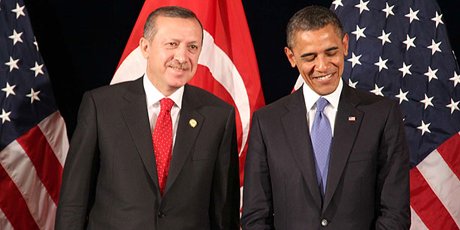
Turkey and the US have seen their ties, lauded by officials of both countries as a "model partnership," tested by deepening crises in the Middle East -- particularly in Iraq and Syria-- but the relationship has survived the challenge.
The US completed the withdrawal of its troops from Iraq on the eve of this year, as part of the “leading from behind” policy of President Barack Obama. The country has continued to prepare for an end to its military mission in Afghanistan throughout 2012, in the aim of leaving the country's security to Afghan forces.
After the US's withdrawal on Dec. 31, 2011, some Turkish political circles expected that Turkey would play a large role in consolidating Iraq's stability, as a broker in disputes between Sunni and Shiite factions, and between the Kurdistan autonomous region and the central government.
However, these expectations have been dashed, and Turkey has had a rough period with Iraq's Shiite administration, which waged a political war against their opponents following the pullout of US troops. The government of Prime Minister Nouri al-Maliki has called Turkey's efforts for reconciliation between his government and Sunni and Kurdish blocs an intervention into Iraqi affairs.
Additionally, after the US withdrawal, Iran has gained a visibly greater degree of control over the country, thanks to its close relations with the Shiite al-Maliki government. For Turkish analysts, thus, the US pullout from Iraq in 2011 amounts to “serving Iraq to Iran on a golden platter.”
Meanwhile, the latent conflict between Iran and Turkey over establishing dominance in the Middle East, which has escalated due to the ongoing Syrian crisis, drew Turkey closer to the US in 2012. Ankara has come to increasingly perceive Iran as the leader of an emerging de facto Shiite front seeking to curb Turkish influence in the Middle East in 2012, particularly after Iran resumed previous support for the terrorist Kurdistan Workers' Party (PKK) and began to give increased backing to the Syrian regime as it suppressed its opponents with brutal force.
Although Turkey and the US have shared the same discourse on the resolution of the Syrian crisis, with both of them seeking the establishment of a transitional government, the former wants a much faster transition, as the effects the Syrian war are felt immediately in Turkey. Turkey's desire for a more rapid regime change in Syria has led it to ask the US to more directly support the Syrian opposition.
There is strong political opposition within the US against creating buffer zones in Syria, which would be useful in preventing a refugee influx to neighboring countries including Turkey. Those opposed believe that any such measure would mean a military intervention into conflict-torn Syria.
The US, however, did agree in November to send Patriot air-defense missiles to aid Turkey in case of a missile attack on NATO-member Turkey's territory from Syria.
Meanwhile, Obama's re-election for a second term in office in November contributes to the stability and continuity of Turkey-US relations.Other than that, 2012 was not very fruitful in terms of the Turkey-US partnership on counterterrorism. The US failed to provide Predator drones to Turkey in May, which could be used as a measure against the PKK, which launches attacks on Turkey from northern Iraq. The US Congress refused to agree to a sale of aircraft to Turkey, partly due to Ankara's deteriorating relations with US ally Israel.
Congress is also noted as being suspicious on entrusting further US drone technology to Turkey after Turkey's alleged mistake in the Uludere incident, in which 34 people were killed in a strike by Turkish jets while crossing the border from Iraq into Turkey on their way back to their village.
Also, speculation appeared in the media in May that intelligence leading to the Uludere airstrike was provided by the US, which has harmed the US's image in among Turks. The Turkish military has yet to reveal the source of the intelligence used in the operation.
Meanwhile, Turkey's intermediary role in the Iranian nuclear crisis continued to gain it favor in Western countries during 2012. The latest nuclear talks between Iran and Western governments in İstanbul in April were deemed a great opportunity for a diplomatic solution to the crisis, and both sides appealed for Turkish assistance when a deadlock loomed during the talks.
Economic relations
Trade volume between the US and Turkey showed a slight increase in 2012, compared to the previous year, rising to $16.8 billion in 2012 from $16.7 billion in 2011.
In 2012, US and Turkish economy officials reiterated that bilateral trade between the two had not reached its potential, saying that there is still room for a dramatic expansion in commercial ties.
The model partnership initiated jointly by Turkey and the US in 2009 signifies the willingness by the countries to add new dimensions to bilateral ties, which have long been dictated by security concerns and short-term interests. Strengthening economic ties beyond trade dominated by military hardware has been a cardinal objective of the new mode of bilateral strategic engagement expressed in the terms of the model partnership. In this context, the two governments launched the US-Turkey Framework for Strategic, Economic and Commercial Cooperation (FSECC), which entailed a new cabinet-level initiative to tackle challenges to enhancing economic relations with a more structured private sector involvement through a business council composed of representatives from both countries.
The European fiscal crisis and recent turmoil in the Middle East and North Africa have made the United States an even more important target in Turkey's efforts to diversify its trade ties.
One of the chief projects for the economic aspect of this model partnership is making the city of İstanbul a global financial center, a goal also emphasized by US officials in 2012.
Model partnership with US survives Mideast challenges
Turkey and the US have seen their ties, lauded by officials of both countries as a "model partnership," tested by deepening crises in the Middle East -- particularly in Iraq and Syria-- but the relationship has survived the challenge.