

The Turkish state will begin its Kurdish broadcasts starting in January. The use of Kurdish was prohibited following a 1980 military coup until the year 1991. The TRT aired test broadcasts on Thursday in two Kurdish dialects, Kurmanji and Zaza. Full broadcasts will start on Jan. 1.
The TRT's Kurdish channel, TRT 6, broadcast interviews about the project and played Kurdish music in its test broadcasts. In an interview with Today's Zaman yesterday, TRT 6 Coordinator Sinan İlhan said the Kurmanji dialect will be used for the first broadcasts and other Kurdish dialects will be included gradually as the channel moves forward. The TRT will also have separate channels broadcasting in Arabic and Persian in the future, İlhan added.
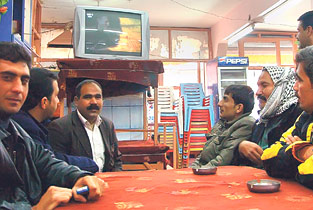
The new channel was welcomed by many Kurds. İbrahim Halil Şahin, a resident of Şanlıurfa, told reporters yesterday that he was very happy to have finally a state channel broadcasting in his native language. " If they do things like this in Turkey, the southeastern people will see this positively," he said. Şanlıurfa Young Businessman's Association (ŞUGİAD) Chairman Mehmet Öksüzoğlu said everyone who wants Turkish unity and to protect Turkey's integrity should be proud. " I see it as a late but extremely positive step," Öksüzoğlu said.
İlhan also said the reaction so far has been very encouraging. " Frankly, we have gotten so many telephone calls of thanks and congratulations for the test broadcast. We now know that viewers have really high expectations for regular broadcasts, which shows that we have a tough job ahead," he said, adding that they knew there would also be negative reactions, but that the congratulations and thanks have made up for the negative reactions.
In the province of Muş, resident Abdullah İbrahimoğlu said: " This is a democratic step. We see this as an important step for freedom, brotherhood and peace." He added that he hoped the TRT 6 would become an important instrument in preserving the Kurdish language and culture and explained that the channel would help standardize the language, making it easier for a Kurd from Muş to understand another one from Diyarbakır or Van or Şanlıurfa.
Refik Korkusuz, an assistant professor in the law department at the Diyarbakır Dicle University, said, " Those who wanted Turkey's unity also wanted to have a sense of belonging and expected Kurdish TV because of that. I think this is a delayed but very positive development; I wish the best of success and that it becomes an important milestone in our brotherhood."
Stating that there are currently 15 Kurdish channels broadcasting, Korkusuz noted that the TRT would make a great difference. " The TRT has important programs that meet local people's demands," he said.
Kurdish writer Altan Tan noted that some segments were unnerved by the TRT's Kurdish broadcasts. " There are those who want peace, and then there are those who want war. Kurdish television is for those who want peace. Some are openly disturbed. But the initiative should continue. Those who want peace should add new steps to similar initiatives," said Tan.
The PKK versus TRT 6
The terrorist Kurdistan Workers' Party (PKK) launched what can easily be called a smear campaign against the new channel. Murat Karayılan, a PKK commander, referred to the TRT's Kurdish TV project as a " tightrope walker's game." In a message he sent to PKK sympathizers, Karayılan called for a boycott against the channel. " Such a television channel project and discussions on opening Kurdology departments at some universities actually have a weakly organized war plan underneath. These have a target of hurriedly making some broadcasts to win votes for the Justice and Development Party [AK Party] before the elections. Taking part in this project and supporting it is betraying the cause of Kurdish freedom," he said.
The PKK's news agency, Fırat, also broadcast a number of stories bashing the TRT's Kurdish broadcasts. In the latest such story, Fırat printed negative opinions taken from İstanbul Kurdish Institute President Sami Tan, Mesopotamian Culture Center Administrator Çetin Filirz and Kurdish-language Gün TV2 General Manager Diren Keser.
The pro-Kurdish Democratic Society Party's (DTP) Co-Chairperson Emine Ayna said the Kurdish channel was an attempt to deceive people. Other DTP deputies, such as Şanlıurfa deputy İbrahim Binici, said the Kurdish channel was a move targeting the local elections.
DTP Batman mayoral candidate Nejdet Atalay said, " For years, Kurdish was recorded in police records as an 'unidentified language.' They used to tell us that Kurds do not exist. Now they are going to tell us that there is no such thing as Kurds in Kurdish."
Kurdish intellectuals support the channel
Not all prominent individuals in the Kurdish movement have been strongly critical of TRT broadcasts in Kurdish. Former Diyarbakır Bar Association President Sezgin Tanrıkulu said: " This is an important and serious step. This shows that the state has moved on from the stage of denying the existence of Kurds to acknowledging Kurds. We can discuss the content of the channel, but regardless of all of that, it is important that a public broadcaster is allocating one channel for this."
Kurdish intellectual Tarık Ziya Ekinci told Today's Zaman that a television studio outsourced by TRT 6 shot a 45-minute documentary with Ekinci. " I talked about my biography and my family in Kurdish," he said. However, he also had criticism. " This is an important step, but the legal basis should also be provided. You do this at one point, but in some other place, a judge convicts someone for singing a song in Kurdish. Steps that would establish this as the overall state mentality in the citizens' viewpoints are needed. Without doing these, Kurdish TV is starting from the end," he said.
Some would like to see the move as a positive move, but remain skeptical. Seydi Fırat, a spokesperson for the Peace Council, said: " The broadcasts should be appreciated. But we do have doubts. There is the worry that the state might use it for political purposes, to make its own policies dominant. There have been television stations broadcasting in Kurdish for years, so I don't think it is a novelty. But if there is going to be such broadcasting, it shouldn't be done with the state mentality. If the channel can be a place where people can express themselves individually, then it would be a positive step."
TRT 6's frequency
Satellite position: 12685,
Vertical (V)
Symbol: 30000
FEC: 5/6


