

He said that NATO warships were already escorting food aid shipments to Somalia and patrolling the Gulf of Aden, but he did not see the alliance getting involved in any land operations against pirate bases in the region. "I do not expect a NATO role in operations to wipe out piracy in the Horn of Africa," de Hoop Scheffer told reporters during a visit to Ghana.
De Hoop Scheffer stated late on Wednesday that NATO is committed to helping improve security in Africa but expects African states to take the lead in fighting piracy off the continent's shores. De Hoop Scheffer was responding to a call by Ghana's defense minister for closer collaboration between African regional bodies and NATO to combat piracy off Africa's coasts and tackle other security problems such as money laundering.
The NATO chief spoke during an international alert over piracy off the Horn of Africa, where Somali pirates have caused havoc in one of the world's busiest shipping lanes connecting Europe to Asia and the Middle East. "This continent still has many problems, but it is my strong conviction that Africans should be in the lead to find solutions for those problems, and not others," de Hoop Scheffer said after arriving in Ghana on Wednesday.
"I do think that NATO could do a lot in being instrumental, for instance, by intensifying training for the African Union standby force to enrich their experience, which could then be used to reach out appropriately where it is needed to solve Africa's problems," he said. Ghanaian Defense Minister Albert Kan-Dapaah called for closer collaboration between the African Union and sub-regional organisations like the Economic Community of West African States in particular to fight a rise in piracy off West Africa.
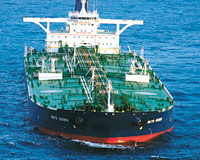
Armed groups there have become more daring in their seaborne raids, especially off Nigeria's oil-producing Niger Delta. Militants from Cameroon's nearby Bakassi peninsula freed 10 mostly French hostages last week after holding them for nearly two weeks. Off east Africa, Somali pirates on Saturday seized a supertanker carrying $100 million worth of oil in the biggest ship hijacking in history.
"We need to act in concert to face these challenges by working closely to share intelligence and information on how best to turn the insecurity situation around," Kan-Dapaah said, adding that no single country could tackle the problem alone.
"We need to search for global solutions to global concerns and we must develop reliable consultations and set up mechanisms to fight the security challenges we face today," he said. Russia's ambassador to NATO said on Wednesday the 26-member alliance should launch land operations against the pirates' land bases in Somalia alongside European Union forces and in coordination with Russia.
Somali politicians fuel piracy, says African Union's top diplomat
The growth in piracy off Somalia is being aggravated by the country's feuding politicians and the United Nations should send peacekeepers there quickly, the African Union's top diplomat said on Thursday.
Gunmen from the chaotic Horn of Africa country grabbed world headlines with last Saturday's spectacular capture of a huge Saudi Arabian supertanker loaded with $100 million worth of oil, the biggest ship hijacking in history.
Jean Ping, chairman of the African Union Commission, said the increasing piracy was "a clear indication of the further deterioration of the situation with far-reaching consequences for this country, the region and ... international community."
Scores of attacks in Somali waters this year have driven up insurance costs for shipping firms, and even made some companies divert cargo around South Africa's Cape of Good Hope. Forces from NATO, the European Union and elsewhere are trying to protect vessels on one of the world's busiest shipping routes, linking Europe to Asia. Some nations seek a more robust response and say attacks will continue without political reconciliation onshore, where an insurgency rages.
Since seizing the supertanker Sirius Star, Somali gunmen have hijacked at least three other ships, maritime officials say. Saudi Arabia's foreign minister said on Wednesday the owners of the Sirius Star were in talks over a possible ransom.
The tanker was seized 450 nautical miles southeast of Mombasa, Kenya -- far beyond the gangs' usual area of operations. It was believed to be anchored near Eyl, a former Somali fishing village that is now a well-defended pirate base.
The ship was carrying as much as 2 million barrels of oil, more than a quarter of Saudi Arabia's daily exports. The audacity of the attack underlined the extent of a crime wave that experts say has been fuelled by the Iraq-style insurgency onshore, dimming hopes for UN-led peace talks, and the lure of multi-million-dollar ransoms.
Somali gunmen are believed to be holding more than 200 hostages and about a dozen ships in the Eyl area, including a Ukrainian vessel loaded with 33 tanks and other heavy weapons. An associate of the gang holding that ship, the MV Faina, said they rejected a $2.5 million ransom offer this week.
"The pirates and a broker met in the forest between Galkayo and Haradheere ... but the pirates stood by their demand for $8 million," the associate, Hussein Hassan, told Reuters. Mogadishu Reuters


