

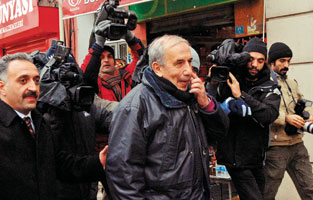
" I think in the new indictment, we will see the names that would compose the Cabinet after an intervention in politics. The investigation is going in that direction," says Avni Özgürel, a journalist who is an expert on the history of the " deep state," a term used in Turkey to describe the phenomenon of illegal gangs nested within the state hierarchy carrying out behind-the-scenes operations, often aimed at manipulating public opinion.
He recalled that after the 1996 Susurluk investigation was not taken seriously, the post-modern Feb. 28 coup took place. The Susurluk investigation started when a former police chief, a southeastern tribal leader whose men were armed by the state to fight separatist violence, and an internationally wanted mafia boss were involved in an accident near the small township of Susurluk while riding in the same car.
The police chief and the mafia boss, as well as his girlfriend, a former model, were killed in the accident. No serious arrests followed in the ensuing investigation, which exposed, for the first time in modern Turkish history, a gang with links to the state.
Özgürel said the Susurluk scandal taught some circles that even without direct interference, it is possible to establish a government by putting illegal pressure on politics. They tried to do the same during the Ergenekon case, Özgürel says, and if the Ergenekon investigation does not go deeper and is not backed by political will, Turkey will discuss the same subjects in the near future, too.
"What is under investigation is now trying to form a minority government with the power of arms," Özgürel said. "I think the indictment will mention the coup attempts."
Lawyer Yusuf Alataş, the former chairman of the Human Rights Association (İHD), said he is also expecting references to 2004 recent coup attempts in the new Ergenekon indictment.
"Another indictment will be prepared, and if there are new direct links with the suspects, the new case would be merged with the ongoing trial, though we don't know the details yet," Alataş said.
According to him, in any case, Turkey will no longer be same country because most of its taboos will have been broken.
"Although it is possible to say that some suspects could have been invited to the public prosecutors' offices to give their testimonies instead of being detained, these detentions strongly showed the public that no one is untouchable," he said. "This gave the strong message that everybody is accountable."
Alataş added that until now, those who were not the victims of the illegal activities done by state officials had difficulty believing that it could happen.
"The possibility that state officials could commit crimes was considered a conspiracy theory. It is not possible to change this perception totally, but the recent investigation opens the way to confront the past," Alataş said. "From now on, the unsolved murders and summary executions will be on the agenda. Thirdly, some people until now were hiding behind some holy ideas like 'flag' and 'nation.' The public learned very well that the people who are using these terms are not always innocent. Finally it is understood that the struggle against terrorism is not always clean. When you consider all of these improvements, whatever the result of the investigation, it is possible to say that everything will be better in Turkey."
Retired military Judge Ümit Kardaş points out that that the prosecution might prepare a third indictment for the recent arrests in addition to the ongoing trial and the other suspects who have not yet been brought to trial.
Kardaş adds that the future of the investigation depends on political will but that he shares similar views with Alataş, also noting that Pandora's box has been opened.
"What we are facing now is not unbearable anymore, and reconstruction is inevitable," Kardaş says.
Özgürel also emphasizes the importance of reconstruction and says the army is positive in that regard.
"Of course there is uneasiness within the army," he says. "It is disturbing to see that some of their former commanders are detained. But I think the Turkish Armed Forces [TSK] wants an inner cleansing and to get rid of some elements who were not obeying the hierarchy of the army." AYŞE KARABAT ANKARA


